
Mission Briefing
Aura's investor said she needed a company in Delawhirl, the tiny system whose charter law every big fund knows by heart. She believed it, because everyone believes it. Six cycles and $10,400 later, her Nairobuine startup had a new United Stars parent. Then her home tax office sent a bill for $23,000 on something nobody had mentioned. This issue is about the most expensive sentence in frontier-system fundraising.
Venture Odyssey
Departure: The round that needed a different company
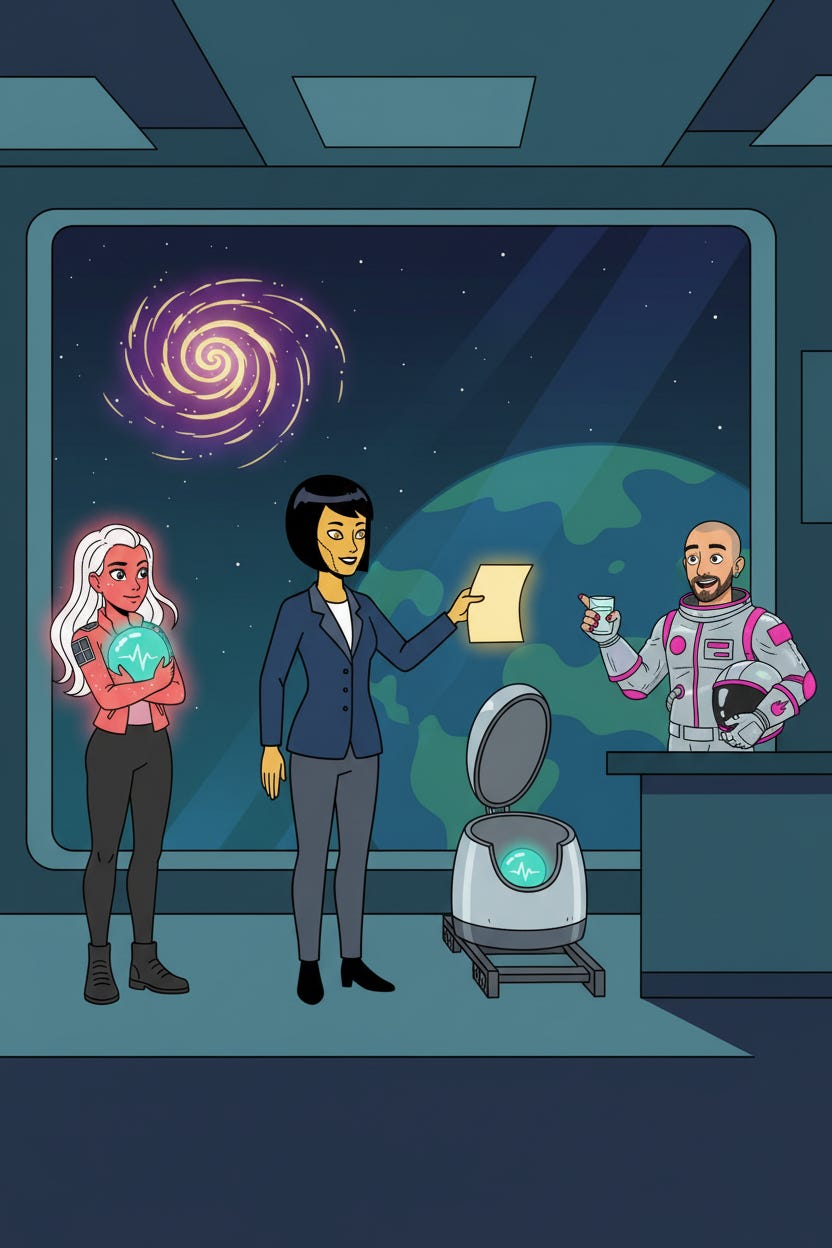
: Three good meetings. One condition.
From the Guide: Auriga. Famous for its star clusters, and for founders who keep score in lives instead of dollars.
I met Aura at a trade summit on the Nairobuine orbital ring, the kind held in a converted docking bay where the canapes float slightly if you don't eat them fast enough. I had my helmet under my arm and a shuttle to catch, so I was doing what everyone does at these things: standing near the bar, pretending to read my wrist.
She was hard to miss. Coral skin with a glow that brightened when she talked about her work, which was always, and white hair whose tips lit up like something from the deep ocean. A hologram floated above her palm, counting patients. It never stopped counting. She had built a health data platform for community clinics across the Afrinebula, two years of real product, real users, real diagnoses that would not otherwise have happened. Her company was incorporated in Kenyarion, built slowly and on purpose, by a founder who chose the harder problem because the easier one bored her.
Across the bay, a fund partner was working the room. Auri ran health investments for an impact fund three systems over, the kind with a real mandate and a real check. She was from Auriga too, which is why everyone at the summit kept mixing up their names, and why neither of them found it funny anymore. Same constellation, very different jobs. Aura builds. Auri deploys capital, with conditions. Her face was perfectly proportioned in a way that took you a second to notice, and a glowing side letter, sixty pages thick, hovered at her elbow the way other people carry a phone.
They talked for twenty minutes. Then twice more by holographic transmission, each one better than the last. Auri had written checks into three similar companies in the past eighteen cycles. She knew the market. She liked the numbers. She liked Aura more.
The third transmission ended with a sentence Aura had heard from every United Stars fund she had ever pitched.
"We'll need a Delawhirl company," Auri said. Not a request. A fact, delivered the way you mention gravity. "Our fund invests through a United Stars entity. A Delawhirl C-corp is the standard. Once you have that, we move."
Aura nodded. She called a lawyer who handled cross-border structures for Afrinebula startups and said the words founders say every cycle: "I need to flip to Delawhirl."
He could do it. Eight to twelve thousand dollars, depending on complexity, converted that morning at the interstellar exchange before the Reticulan markets did whatever they do on Thursdays. Six cycles, start to finish. She asked if there was another way. He said United Stars funds almost always want a United Stars company.
She said go.
The next six cycles went to paperwork. A Delawhirl company was formed. Her shareholders swapped their Kenyarion shares for Delawhirl shares. The Kenyarion company became a subsidiary. The cap table moved across the galaxy without anyone's ownership changing on paper. The final invoice was $10,400. She told her team the company had a new parent and nothing else would change.
She was almost right.
Layover: The asset that crossed the border
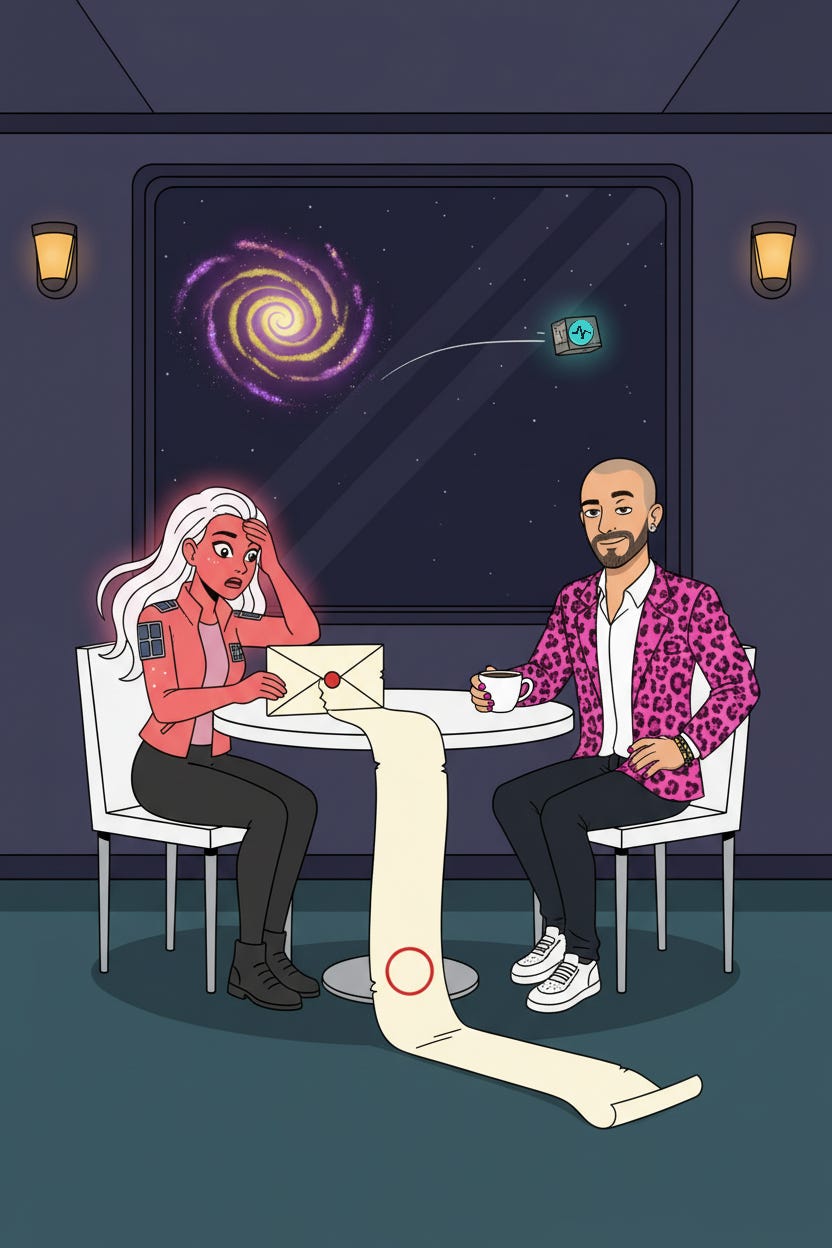
: The bill was not for the shares. It was for the platform.
From the Guide: Tax offices, across most of the known galaxy, are the only institutions that never forget a transfer.
Here is how a flip works, and why it usually feels harmless. The shareholders trade their shares in the local company for shares in a new Delawhirl parent. Same owners, same percentages, one new layer on top. On paper it looks like rearranging furniture.
But the platform was not furniture. Two years of code and clinical data models, built by her team in Nairobuine, owned by the Kenyarion company. Auri's counsel wanted the platform to sit with the parent, the company the fund was actually buying into, rather than licensed up from a subsidiary. So as part of the flip, the platform itself moved. Not the shares. The asset.
Her lawyers moved it at cost: what the company had spent building it. They had paperwork for the intercompany transfer. What nobody had ordered, because nobody had asked, was a valuation of what the platform was actually worth on the day it moved.
That matters because of a rule that shows up, in one form or another, in many tax systems. When two related companies trade with each other, the tax office does not have to accept the price they picked. It can ask what strangers would have paid. A parent buying from its own subsidiary can set any price it likes. The tax office can set a different one.
A few cycles after the flip closed, a notice arrived from her home tax office. It asked how the platform had been valued and what it was worth on the day it left. Aura forwarded it to her lawyer and called him by transmission.
"We moved the platform at cost," he said. "That was the intercompany price."
"Is that the right price?"
A pause that cost nothing and said everything. "For tax purposes, the test is usually what an unrelated buyer would have paid. If they decide the platform was worth more than what we booked, they can tax the difference."
"What was it worth?"
"That's what a valuation would have told us. We didn't commission one."
The assessment came back with their own number. The tax bill was $23,000.
Two cycles later, she found me at the same docking-bay cafe where we had met, and this time I was in my pink leopard blazer, the one I wear when nobody is flying anywhere. She put the notice face down on the table, which is the universal gesture for "I have read this enough times."
"Is their number right?" she asked.
"I can't tell you that without the file," I said. "I can tell you why they sent it. When valuable IP moves between related companies, somebody has to put a price on it. If you don't, someone else will."
"My lawyer never mentioned it."
"Corporate lawyers run the corporate steps. The tax side usually needs its own adviser, in your home country, before anything moves. Nobody put that adviser in the room."
"Could we have done it differently?"
"Maybe. Keeping the platform where it was and licensing it, with a proper study behind the price, can land very differently. But here's the question I'd ask first." I turned my cup around. "Did the fund's documents actually require Delawhirl? Or did a partner say so in a meeting?"
Her hair tips dimmed. "She said it was required."
"Did their counsel say it?"
"I never asked."
She asked that same cycle. Auri, who was not hiding anything, sent the question to her fund's counsel, who came back in two cycles. The fund preferred a United Stars entity. Its documents also carried an exception for frontier-system companies where a flip was impractical or created material tax cost at home. An investment straight into the Kenyarion company, with the right protections, would have been allowed.
Nobody had lied. A preference had been repeated so many times it started sounding like a law.
Arrival: The most expensive sentence in fundraising
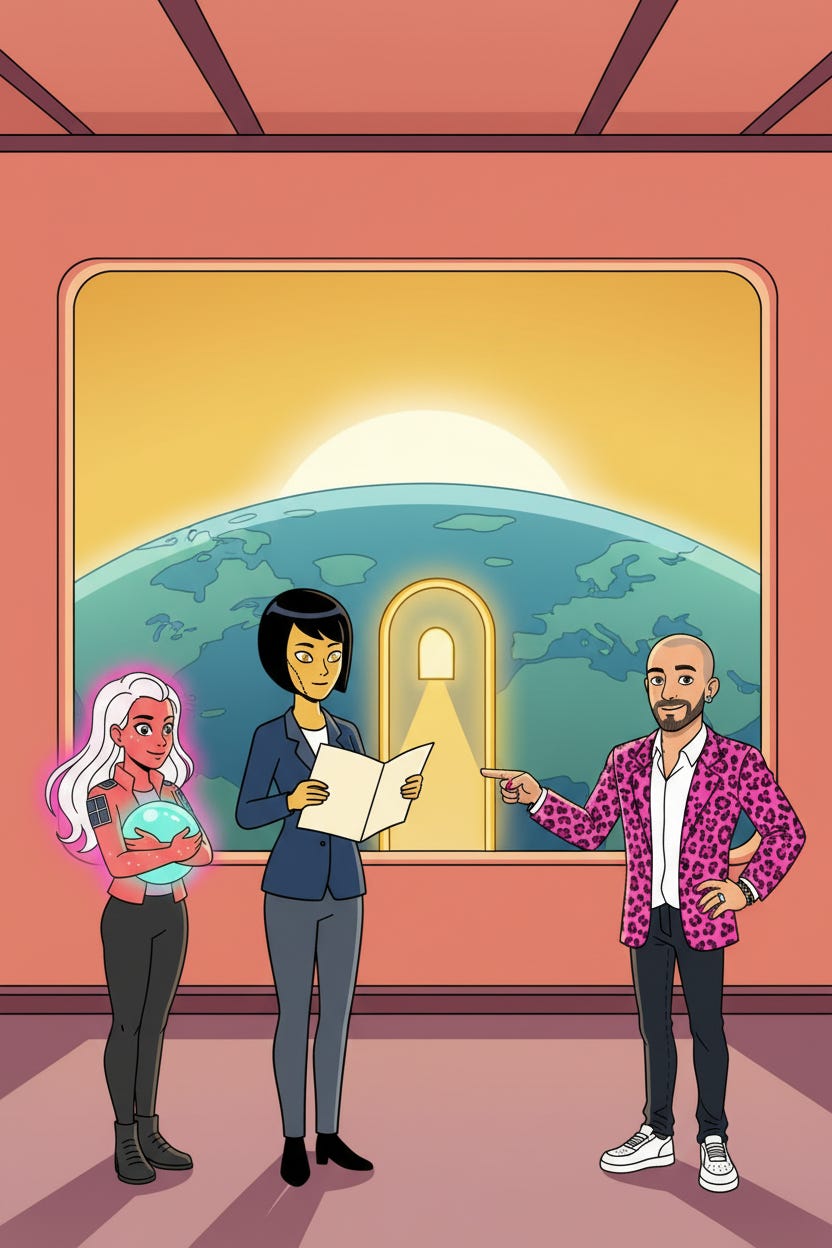
: Ask for the requirement in writing.
From the Guide: A prerequisite that nobody can show you in writing is a preference wearing a uniform.
$10,400 in fees. $23,000 in tax. Six cycles of a founder's attention, which is the scarcest currency in any system. All of it hanging on one question nobody asked in the third meeting.
Let me be fair to Delawhirl. It is a sensible default. Clear corporate law, a court that has seen every venture fight twice, and a century of precedent that United Stars funds and their lawyers already know by heart. Plenty of founders flip and are glad they did. The advice is not wrong.
What goes wrong is treating it as automatic. A flip has a price tag, and most of it is invisible on the day you start: the legal fees, yes, but also the tax treatment of anything valuable that moves, the cost of running two companies in two places, and the filings that come with each. Those costs can be estimated before the first document is signed. They usually aren't, because the decision was made in a sentence, and sentences don't come with invoices.
Think of it like getting a visa for a country you could have entered with your current passport. The application is real work. The fees are real money. The embassy is perfectly polite. Nobody checked whether the rule applied to you, because everybody assumed it did.
The details change by country and by year, which is exactly why this is a pattern and not a rule you can look up once. Every flip decision runs through the same three questions. Is it actually required, in writing? What moves, and who prices it? And does the total cost make sense against the round it unlocks?
Aura's next round went into the structure she already had, with an investor whose counsel answered the question in the first meeting instead of the sixth cycle. Her hologram is still counting patients. It never stopped.
The Blueprint

From the Guide: Before you move house, find out whether the landlord actually asked you to.
Get the requirement in writing. Ask your investor which document requires a United Stars entity and whether it has an exception for companies like yours, and ask their counsel, not the partner. Done looks like: an email from the fund's counsel naming the clause, or confirming there isn't one.
Price what moves before it moves. If a flip shifts IP, data or contracts from your local company to a new parent, get a tax view from an adviser in your home country before the documents are signed, including how the transfer will be valued. Done looks like: a short written memo on the tax treatment and the valuation method, dated before signing.
Put the whole flip on one page. Legal fees in both places, tax on anything that moves, the yearly cost of running two companies, and the size of the round it unlocks. Done looks like: one page with a total, a round size and a go or no-go decision, made before any restructuring work starts.
Free resource: The IP Assignment Pack. A quick readiness check plus templates, so you can prove who owns your IP before anyone asks you to move it. See below.
The Free Resource
The IP Assignment Pack. Before any IP crosses a border, you need to know who owns it today: founders, employees, contractors. Run the quick readiness check, then take the templates for co-founders, hires and contractors. Runs in the browser, no third-party sign-ups.
Curious Corner
Three outside reads from people who do this for a living.
Orrick Founder Series: Top Tips to Follow When Flipping: A startup law firm's checklist for the flip, from IP licensing to SAFEs, notes and tax. Read it before the call where someone says "required," so you know which questions to ask back.
Gust: Reincorporating Your Startup Through the Flip: How the share swap works and when it can be tax neutral for the company and its shareholders. Useful for pricing what moves before it moves, which is Blueprint move two.
Chalmers University: The Drivers, Mechanisms and Trade-offs of the Flip: A 2026 thesis that interviewed founders who flipped and found the move driven mostly by investor pressure, with limited signalling value of its own. Auri's story, with footnotes.
The Question
Think about the last time an investor told you something was "required," and you said yes before the call ended. Did you ever see it in writing, and what did saying yes cost you? Hit reply, I read every one.
Writing this from the Maldives, where the only thing I have flipped this cycle is myself on a sun lounger, badly. Next issue: the founder who owned 34% of his company and still lost the vote that removed him. Now go ask the question everyone else in the room is too polite to ask. Pepe
The Outlaw Chronicles is for education only. Nothing here is legal advice. For the real thing, you know where to find me.