

Mission Briefing
Ange wrote the first check into a company she loved: $400,000, on a handshake. One clause in the paperwork felt like doubt, so she struck it out. Eight months later the founder left for a new idea. He still owned 90% of the company. This issue is about the one question she never asked.
Venture Odyssey
Departure: The first check
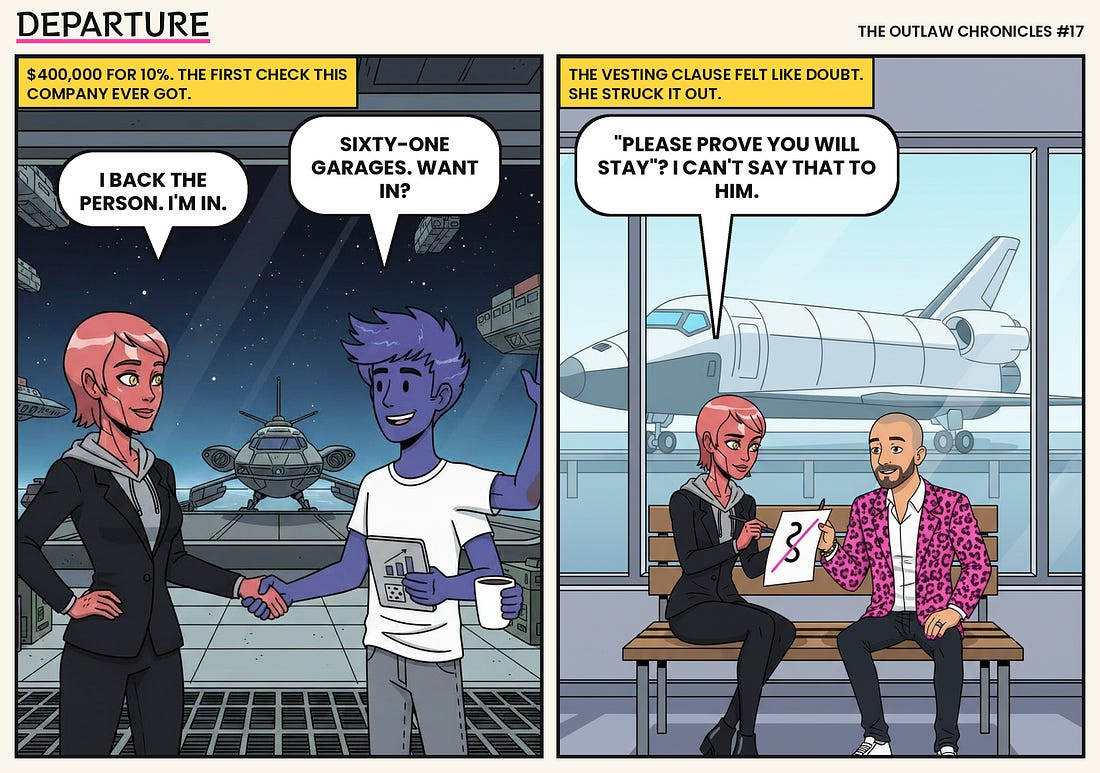
A handshake. One clause struck out.
From the Guide: On every world, the warmest handshakes have the shortest paperwork.
I saw the handshake by accident. I was at a docking bay in my silver flight suit, helmet under my arm, waiting for a shuttle that was late in a way only shuttles can be. Ten steps from my bench, two people were shaking on a deal. One of them had four arms. Three of those arms kept talking while the fourth one shook.
The four arms belong to Pegax. Indigo skin that crackles a little when he gets excited, which is always. Hair that points wherever his last idea went. Wherever he stands, a whiteboard appears behind him, with seven business ideas crossed out and one that is not.
The one that is not crossed out was working. Software for small repair garages across the cluster: which mechanic, which part, which bay, in what order. Sixty-one garages had signed up. Five people on the team. It is the kind of product that is dull at a party and wonderful on a renewal call.
The other hand belonged to Ange. Rose gold skin, a little worn, like a phone that has been carried everywhere for years. Laugh lines. A blazer over an old founder hoodie. She ran a company herself once, which is why she leans in when she listens and why she decides on people fast.
"He explained his product to a mechanic like it was his brother's garage," she told me later. "I write checks for that."
She wrote the first check that company ever got. $400,000 for 10% of the company. (The interstellar exchange was in a mood that morning.) Pegax held 9,000,000 shares. Ange got 1,000,000 new ones at $0.40 each. So the company was worth $4 million with her money in it.
The paperwork had a section called founder vesting. Vesting means you earn your shares over time, so you cannot leave early with all of them. The usual deal is four years. Stay, and you keep earning. Leave early, and the company can buy back the part you have not earned yet, at the tiny price you paid for it.
Ange read that section on the bench next to mine, an hour before the signing. She pictured herself saying to this man, who had just talked about garages like family, "Please prove you will stay."
She took a pen and struck the section out.
Here is the part that makes me wince and smile at the same time. Pegax would have signed it without blinking. He told me later he assumed it was in there.
Layover: The question
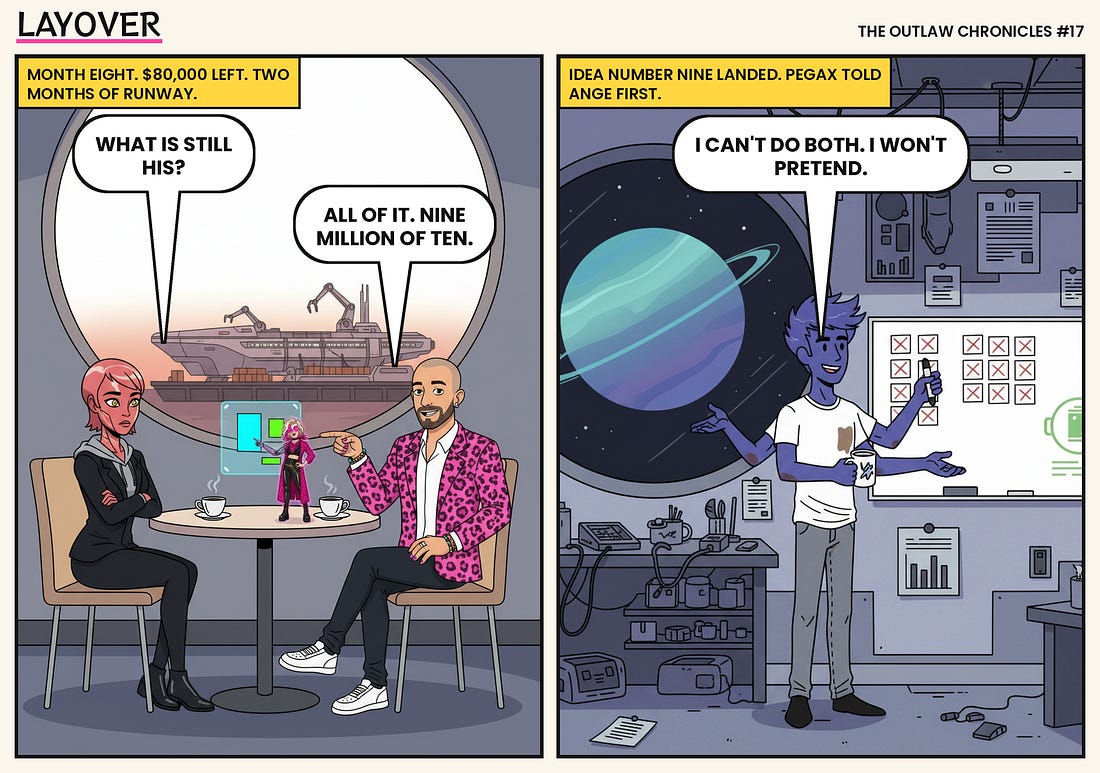
Ninety percent, still his.
From the Guide: Nobody reads the leaving section on a good day. That is the only day it is cheap.
For seven months it was a lovely story. More garages signed. The team of five started finishing each other's sentences. The money went out at about $40,000 a month, on salaries, servers and one very good coffee machine.
By month eight, $320,000 was gone. $80,000 was left. Two months of runway, the time before the money runs out.
Then a ninth idea showed up on the whiteboard. Swapping batteries in small delivery pods. It had been circling Pegax for weeks, and one evening it landed.
What I want you to notice is how he handled it. He did not vanish. He did not sulk. He asked Ange to lunch and told her before he told the team. "I owe you the truth first," he said. "I can't do both. I won't pretend."
Nobody did anything wrong. A man built to chase ideas chased the next one, and he was honest about it. That is exactly why this mistake hurts so much.
Ange asked me to meet her at a dockside cafe. I wore the pink leopard blazer. She had the cap table, the list of who owns what, floating on a small screen between two cups of something that claimed to be coffee. In the corner of the screen she had typed one line.
What is still his?
"Read me his row," she said.
"Pegax. 9,000,000 shares. Ninety percent."
"Of the company."
"Of the company," I said. "And of the votes."
She looked out at the docks for a while. A crew was loading crates onto a freighter with enormous patience.
"If he leaves, some of it goes back. Right?"
"Only if the paper says so," I said. "Yours doesn't. He paid a hundredth of a cent per share. $900 in total. From day one, every share was his. Working here, working on batteries, lying on a beach. Still his."
"My head of operations can run this," Ange said. "She wants a real stake. A quarter."
"From where?" I asked. "New shares need the owners' and the board's yes. Ninety percent of the votes now sit with a man whose whiteboard says batteries. He would probably sign. But every big decision in this company now waits on someone who left."
And the next investor would ask one fair question. Who owns this company, and why is he not here?
Then Ange asked the question she had skipped. Out loud, eight months late. "What would the clause have done?"
"Month eight is before the cliff," I said. A cliff is the first stretch, usually a year, that you must stay before any shares are yours. "On the usual deal, he would have earned nothing yet. The company could have bought back all 9,000,000 shares for the $900 he paid."
Ange did the next sum herself, quietly. At her price of $0.40 a share, those 9,000,000 shares were $3.6 million on paper. All of it sitting with a man who had left.
"So the clause I struck out," she said, "is the one thing I need today."
"It's also the clause that would have made today easy for him," I said. "A friend should not have to negotiate his own way out."
Arrival: The rope
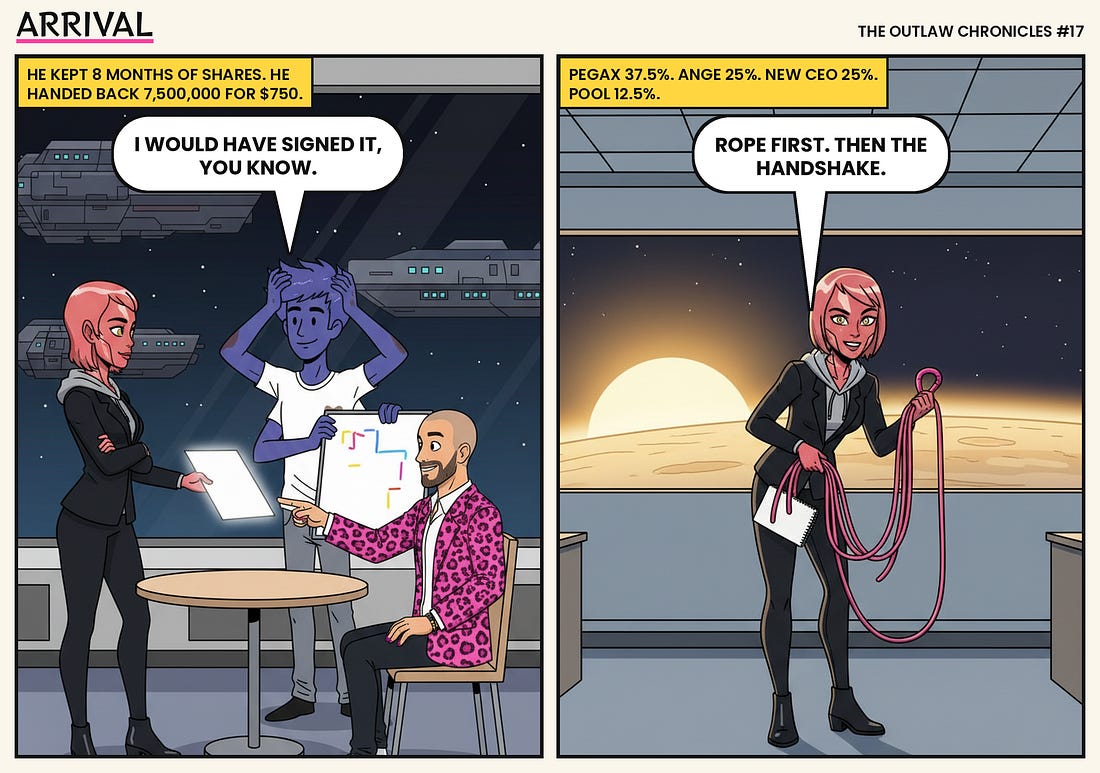
Rope first. Then the handshake.
From the Guide: A rope does not say "I don't trust you." It says "the mountain doesn't care."
The next day Pegax came to the cafe with the new whiteboard under one arm and the other three looking for something to do.
Ange told him what the company needed. A CEO with a real stake. A pool of shares for future hires, which founders call an option pool. A cap table the next investor could read without a headache. Then she said she had no right to ask for any of it, because she was the one who struck out the clause.
Pegax put the whiteboard down. "I would have signed it, you know."
Then he did something easy to admire and impossible to demand. He offered a number. On a plain four year count, month by month, he had earned 8 of 48 months: 1,500,000 shares. He would give the other 7,500,000 back to the company for $750, exactly what he paid for them.
At Ange's price, the shares he handed back were worth $3 million on paper. He gave them back across a cafe table because it was fair, and because he wanted to leave without a debt on his conscience.
The new table was short. Pegax 37.5%. Ange 25%. The new CEO 25%. The pool 12.5%. The company had a captain again, room to hire, and a story the next investor could follow.
Here is what happened, with the sci-fi taken out.
Founders can own their shares on day one and still earn them. The shares are issued up front, and the company keeps a right to buy back the part not earned yet. Four years with a one year cliff is the usual shape. Next to it sit the leaver terms. A good leaver, someone who leaves for reasons the paper calls fair, usually keeps what they earned. A bad leaver, often someone fired for cause, can lose more. Where a plain resignation lands differs from paper to paper, so read yours.
Without any of this, a founder who leaves keeps everything. The only way back is his kindness. Pegax was kind. You should not have to bet $3 million on that.
Ange has a new line at the top of her notes. Rope first. Then the handshake.
The Blueprint
Three things to do this week.
From the Guide: Ask the leaving question while everyone is still smiling.
Find the vesting line for every founder. In every deal you have signed or are about to sign, write down the length, the cliff, and who can buy back unearned shares. Done looks like: one line per founder, such as "4 years, 12 month cliff, company can buy back", or the word "none".
Run the month eight test. For each founder, ask what happens to their shares if they leave in month eight, and at what price. Done looks like: one sentence per founder, "If they leave in month eight, they keep ___ shares and the company can buy back ___ for ___."
Ask before the money moves. Angels: ask for vesting and say it protects both sides. Founders: offer it first, so nobody has to ask. Done looks like: a signed vesting clause in the round papers, or a written reason it was left out that both of you have read.
Free resource: The Month Eight Test. Answer eight questions and see what a founder who quits in month eight keeps, and what the company can buy back. See below.
The Free Resource
The Month Eight Test. Your founder quits in month eight. Answer eight questions about their shares and your paperwork, and the tool writes one sentence: the shares they keep, the shares the company can buy back, and what that costs. Slide the month to see it change. Then get a score out of 100 with three fixes for this week. Pegax's deal is loaded, so you can add back the clause Ange struck out and watch the 90% change. Runs in the browser, no sign-up.
Curious Corner
Three outside reads for anyone about to skip the awkward clause.
The Good, the Bad and the Early: a guide to early-stage founder vesting terms: Peak Capital walks through the usual early schedules and three kinds of leaver. Read it for numbers you can quote when you ask for vesting.
Leaver provisions: balancing founder fairness and company protection: Ashfords on how good and bad leaver are usually defined, and why a plain resignation is not always treated as bad. The best short answer to "what does leaver mean here?"
Demystifying Term Sheets, Part 11: Founders' Reverse Vesting: Cardumen Capital explains the four year schedule with a one year cliff, from the investor's side of the table. Useful for angels who want to know what normal looks like before they ask.
The Question
If the founder you know best left next month, how many of their shares would they keep? Reply with one number, or "all". Then run the Month Eight Test and tell me if you were right. I read every one.
Writing this from Barcelona, where I have learned that the friendliest way to split a dinner bill is to agree on it before the food arrives. Next issue: a founder with two term sheets in one week, who picked the bigger number and kept less of her company. Now go ask the awkward question, kindly. Pepe
The Outlaw Chronicles is for education only. Nothing here is legal advice. For the real thing, you know where to find me.