Mission Briefing
Pegax owned 34% of the company he started at a whiteboard. On a Thursday, the board voted three to two to replace him as CEO. Nobody broke a rule. The clause that did it had been in his shareholders agreement since the Series B closing dinner. This issue is about how 34% of a company can lose a vote.
Venture Odyssey
Departure: Paragraph one at the closing dinner
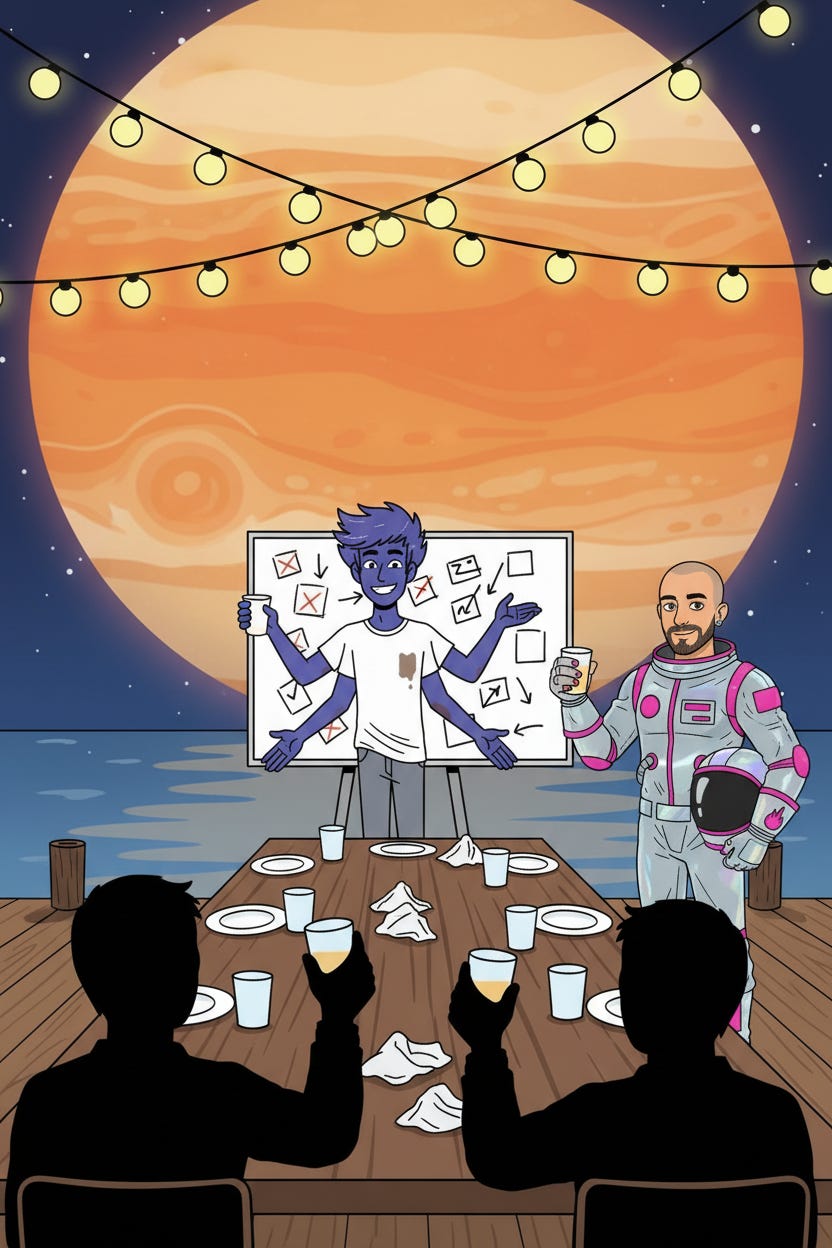
: Paragraph one, read at the closing dinner.
From the Guide: Pegasus. Famous for winged horses and for founders who can hold four ideas at once, because they have the arms for it.
Pegax has four arms. Two from the shoulders, two from the middle of the torso, all of them usually moving. Indigo skin that throws off a little electric shimmer when he gets excited, which is most of the time, and hair that grows in whatever direction the last idea pointed it. Wherever he stands, a whiteboard materializes beside him, covered in seven crossed-out business models and one new one, half written.
The eighth model worked. Pegax built a coordination platform for cargo moving between systems: which freighter, which dock, which customs relay, in what order. Not the kind of product that gets you on a summit stage. The kind that mid-sized shippers renew every cycle without reading the invoice. He pivoted twice to get there. Both pivots were right.
His Series A was led by Perry, from Nova Centauri. Warm amber skin, golden eyes with no white in them at all, and a rolodex hologram that drifts behind him like a loyal moon. Perry is the investor founders hope for. He reads the board pack before the meeting. He makes introductions before he writes checks. He took one board seat and earned it.
The Series B was led by Reti. Crimson lacquered skin, too many teeth, a smile that arrives a half second before the rest of his face. Reti's fund is known for "strong operational governance," a phrase that sounds like a compliment when you are raising and like a weather warning when you are not. Reti took one board seat. His fund also proposed the independent director, a sharp operator from the Vega shipping lanes, and Pegax said yes because she was genuinely excellent.
After the Series B, the board had five seats. Pegax. His co-founder. Perry. Reti. The independent. Pegax owned 34% of the company, more than anyone else at the table.
The shareholders agreement gave him the right to stay CEO unless removed "for cause." Pegax read that definition at the closing dinner, between courses, on a dock overlooking a gas giant, with a glass of something blue that the waiter swore was nonalcoholic. Fraud. Gross misconduct. Criminal conviction. Things that were not going to happen.
He did not read the second paragraph. The second paragraph let the board remove the CEO, cause or no cause, by a supermajority vote if it decided the company's strategy needed different leadership. Supermajority meant three of five.
Dessert arrived. Everyone toasted the round.
Layover: Three of five
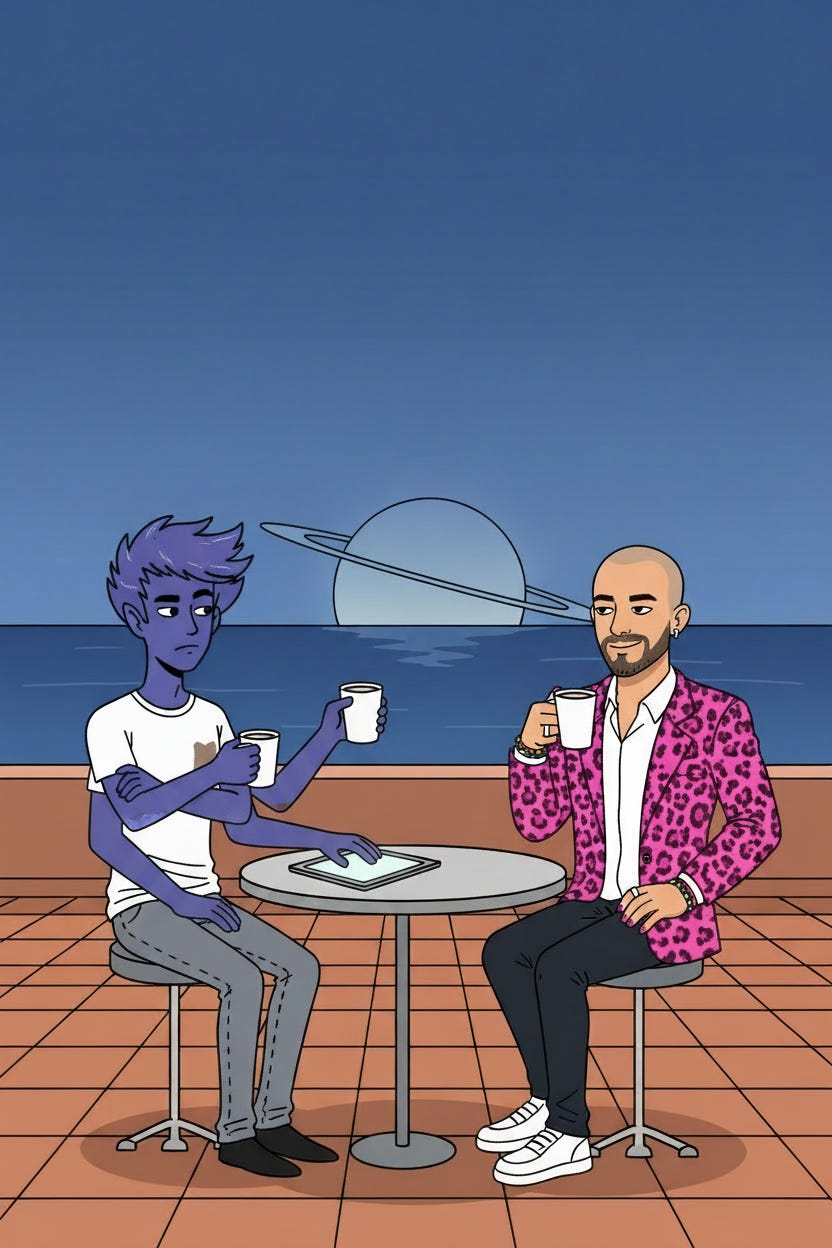
: Three of five. Perry had the third.
From the Guide: Boards, across the known galaxy, are the only parliaments where the opposition can be nominated by the government.
The third cycle after the Series B was hard. Two large carriers launched their own coordination tools and gave them away to their biggest customers. Pegax's growth slowed from 40% a year to 18%. Nobody was in danger. Everybody was nervous.
Pegax did what Pegax does under pressure. He generated. A last-mile product for planetary deliveries. A partnership with three freight unions. An expansion into a sector of the galaxy the company had neither the people nor the fuel for. Every board meeting, the whiteboard materialized, and every board meeting it was fuller. Reti took notes. Perry took longer notes.
After the third quarterly review, Reti's fund sent a memo. It was polite and specific. It said the company needed a CEO who could run one focused plan in a crowded market, and that Pegax's gift was finding the next plan, not finishing the current one. It asked the board to discuss leadership at the next meeting, in two weeks, on a Thursday.
Perry sent a holographic transmission that evening. "There's a conversation coming," he said. "I wanted you to hear it from me first."
Pegax did not call a lawyer. He got on a shuttle. Two cycles later he was in Barcelona, real space, at a terrace near the port, with the shareholders agreement on a tablet and all four hands around one coffee. I was in my pink leopard blazer. He looked like a founder who had not slept since the memo.
"I own 34%," he said, before hello. "They can't fire me."
"Show me paragraph two."
He scrolled. I read it twice, slowly, the way you read a contract when someone's life is in it.
"The cause definition is not the mechanism they'll use," I said. "This is. Three of five board votes, plus a finding that the strategy needs new leadership. Nobody has to prove anything. They just have to count."
"So count."
"Reti is one. The independent is two. Your fund nominated nobody. Reti's fund nominated her."
"She's fair. She'll vote on the merits."
"She probably will. That's the problem. The memo is about the merits." I put the tablet down. "You and your co-founder are two votes against. That makes Perry the whole meeting."
His top two arms crossed. His bottom two did not know what to do. "Perry believes in me."
"Then ask him what he's going to do. Today. Not on Thursday."
He asked. Perry told him the truth, which is what good investors do even when it costs them. He believed in Pegax as a builder. He also had a duty to the people whose money his fund managed, and he was not sure the company needed a builder right now. He would listen to the proposal with an open mind.
On Thursday, Reti's fund proposed a change of CEO. Pegax counterproposed a hired chief operating officer, a sixty-day plan with three numbers on it, and a promise to keep the whiteboard out of the boardroom. The board tabled the motion for two weeks to consider both. In those two weeks, the independent director built a compromise: Pegax becomes Executive Chairman, keeps his seat, his shares and the product roadmap, and the company hires an operating CEO.
Two weeks later, also on a Thursday, the board voted. Reti, yes. The independent, yes. Perry, after a very long pause, yes.
Three to two.
Pegax sent me a ping on the trade-net an hour later. Just a photo of the empty boardroom, five chairs, the whiteboard still glowing faintly where he had been standing. Then a second message: "I had the most shares in the room."
I called him. He picked up on the first ring, which founders only do when they want to argue with someone.
"I did everything right," he said. "I built it. I pivoted when it needed pivoting. I never sold a share."
"You did," I said. "And none of that was on the agenda. The agenda was one question: who runs the company for the next three cycles. Your shares get a say in who sits on the board. They don't get a vote at the table."
He was quiet for a while. Then, very Pegax: "Okay. So what's the next model?"
Arrival: Equity is not a vote
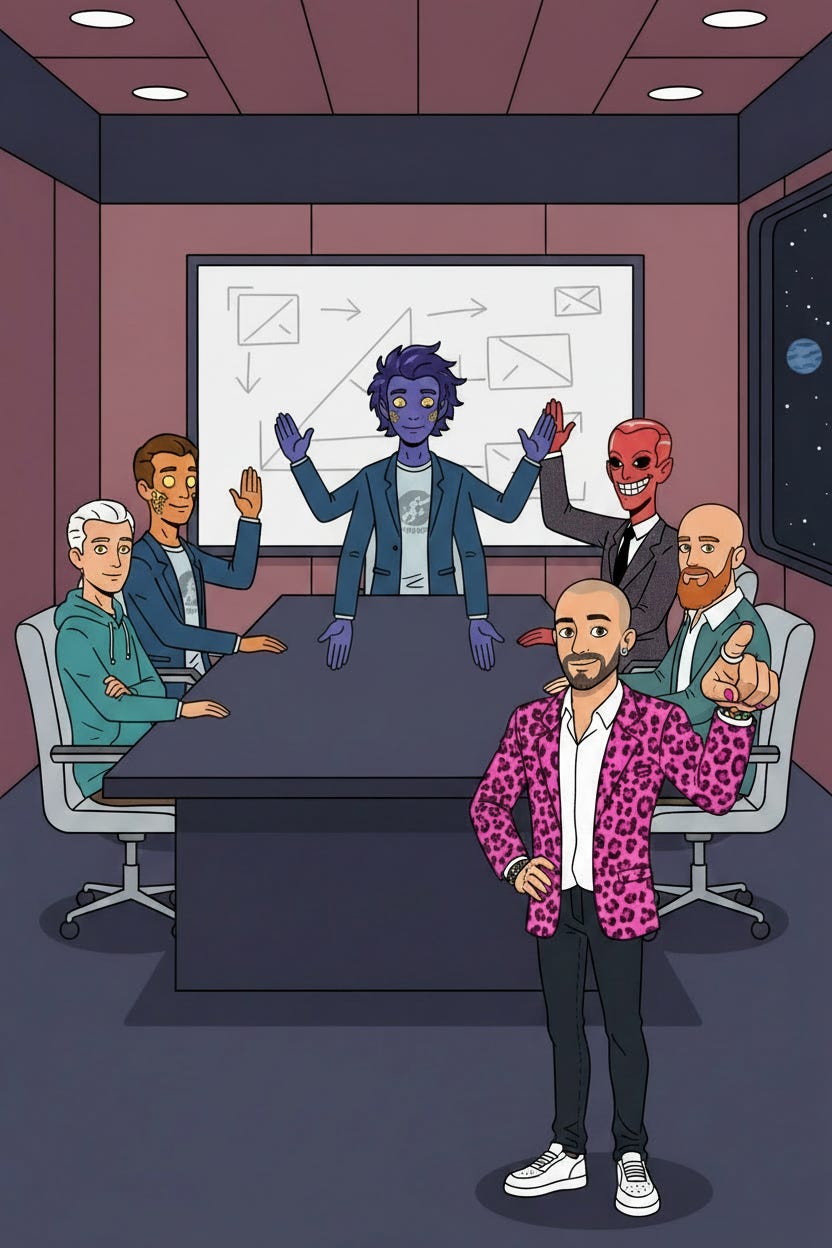
: Executive Chairman. Still 34%.
From the Guide: Owning the ship and steering the ship are two different licenses. Most founders only check the first one.
Pegax still owns 34%. He still sits on the board. The new CEO is competent and kind, ships one plan at a time, and has quietly asked the facilities team to stop the whiteboard from materializing in the main conference room. Growth is back above 30%. Pegax is not sure how he feels about that, which is the most honest sentence a founder can say.
Here is the mechanism, now that the story has earned it. Owning shares and controlling a company are two separate things. Shares carry economics: what you get when the company is sold or pays out. Control lives in the board and in the documents that say what the board can do. You can own the largest stake and still lose every vote, if the board is built differently from the cap table.
Think of it like a parliamentary system. A party can win the most votes in the country and still not form the government, because what matters is the seats in the chamber and who those seats vote with. Pegax won the popular vote. He did not have the seats.
None of this was a trick. Reti's fund asked for exactly what funds like his always ask for, and wrote it down. The independent director did her job. Perry voted the way he believed his duty pointed. The clause sat quietly in paragraph two for three cycles, doing nothing, until the day it did everything.
The founder protections that would have changed this story are ordinary and negotiable: a founder consent right on removing the CEO, an independent director chosen jointly or from a shortlist both sides agree, or a board where founders keep a majority for longer. They are easiest to get at the Series A. Harder at the B. Close to impossible once the seats are filled.
So count your votes in the room you are in, before you need them. The time to read paragraph two is at the closing dinner, before dessert.
The Blueprint
: Three things to do this week.
From the Guide: The cap table tells you who gets paid. The board tells you who gets to stay.
Read both removal clauses in your shareholders agreement today. Find the "for cause" definition and any separate board power to remove the CEO, with the vote it needs. Done looks like: one paragraph, in plain words, describing every way you can be removed and how many votes each one takes.
Count the votes in a removal scenario. List every board seat, who nominated it, and how that seat would likely vote if your investors and the independent sided against you. Done looks like: a written vote count, one line per seat, showing whether a removal motion passes today without your vote.
Negotiate the nomination path and a founder consent before your next round. Ask for the independent director to be chosen jointly or from a shortlist both sides approve, and for founder consent on any CEO removal. Done looks like: a written counterproposal on both points, sent before the next term sheet is signed.
Free resource: Board Composition Model. Put in your seats and see your founder vote percentage and every control threshold before you sign. See below.
The Free Resource
The Board Composition Model. Pick your stage, enter who sits on your board, and see your voting power, whether you still hold a majority on your own, and a health grade for the board you are about to sign up for. Runs in the browser, no sign-up.
Open The Board Composition Model.
Curious Corner
Three outside reads for anyone counting board votes this cycle.
Board dynamics over the startup life cycle: Michael Ewens and Nadya Malenko tracked thousands of venture boards. Founder control usually gives way to shared control, then to investor control, and by the fourth round investors hold the majority in about 63% of companies. Pegax was not unlucky. He was average.
What you need to know about startup boards: A founder and a venture lawyer walk through how seats get added round by round, why the independent director becomes the tiebreaker, and why founders should think about a board role that survives the CEO title.
NVCA model legal documents: The templates most venture lawyers start from. The Voting Agreement is where board seats, who fills them and how they change actually live. Read yours against it before your next term sheet.
The Question
Think about the last board meeting where you looked around the table and assumed you knew how everyone would vote. Have you ever actually counted, seat by seat, what happens if the vote is about you? Hit reply, I read every one.
Writing this from the Maldives, where I'm celebrating the birthday of probably the craziest entrepreneur I've met to date. Next issue: the founder who sold her company for $50 million and walked away with $2.1 million.
Know your vote count. The board meeting is always on a Thursday.
Pepe
The Outlaw Chronicles is for education only. Nothing here is legal advice. For the real thing, you know where to find me.