

Mission Briefing
Aura owned 100% of her company in January. Over the next year, ten friendly people each wrote her a small check, and she said yes ten times. Each yes felt like a few percent. By the time her first real round closed, she owned 41%. Nobody took anything. This issue is about the column nobody adds up.
Venture Odyssey
Departure: Ten small yeses
One small yes. Then nine more.
From the Guide: Nobody on any world has ever said no to a pilot offering money on a bench.
Aura glows when she talks about her work. Not a figure of speech. Her coral skin brightens like a lamp turned up, and the tips of her hair light up and trail behind her like tiny jellyfish. She talks about her work most of the time, so most of the time you could read a menu by her.
Her work is cold boxes. Clinics on the outer settlements lose a third of their medicine because the power cuts out and the fridge gets warm. Aura built a box that keeps vaccines cold for nine cycles with no power at all. (A cycle, out there, is a day, give or take a moon.) A hologram floats over her shoulder that reads, with total sincerity, Lives Changed: 4,721. Revenue: TBD.
In January she owned all of it. One founder, 8,000,000 shares, 100%.
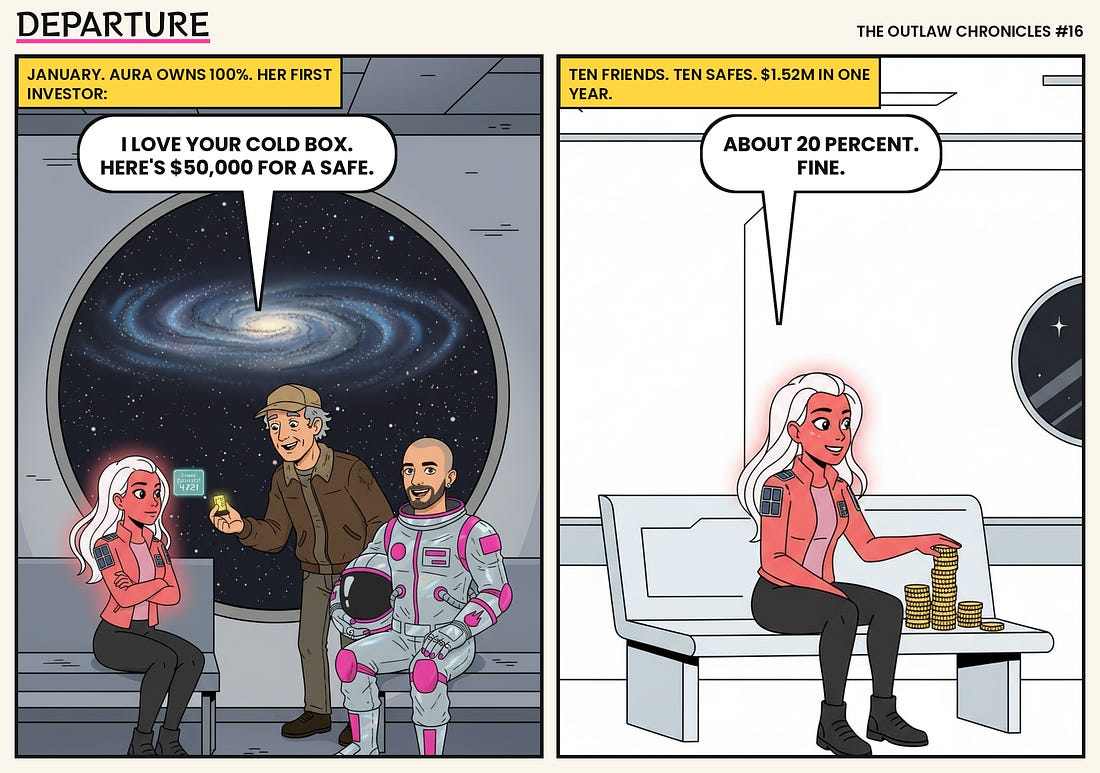
The first check came on a bench in a docking bay. A retired shuttle pilot had watched her demo at a trade summit and followed her outside. "I flew medicine runs for thirty years," he said. "Half of it arrived warm. I want in. Fifty thousand?"
I was on the next bench, in my silver flight suit with the helmet under my arm, eating something that claimed to be a sandwich. I watched her glow go from lamp to sunset.
He offered a SAFE, the standard paper for a first small check. SAFE stands for Simple Agreement for Future Equity. In plain words: money now, shares later, at a price set when a bigger investor shows up. A SAFE has a cap, which is the highest company value the SAFE will use when it turns into shares. His cap was $2 million. She signed it on her knee.
Then word got around, the way good news does on a small station.
Her old professor sent $100,000. The baker below her flat sent $60,000. A cousin sent $150,000, with a message that just said "for Grandma's clinic". A former landlord, a hat maker, a clinic director, a ship broker, a retired judge and a tea merchant. Ten people in one year, every one of them kind, every one of them a believer. $1.52 million in total, on ten SAFEs. Each had its own cap, from $2 million at the start up to $6 million at the end, because the company was worth more every time.
Each check felt small. Two percent here. Five percent there. Aura kept a list on her wrist hologram, and after the sixth check she stopped adding it up and wrote two words at the top.
About 20.
Layover: The pencil
Thirty-six and a half.
From the Guide: The most dangerous number in any galaxy is the one with "about" in front of it.
By the next autumn the boxes were in forty clinics and the money had four months left. Time for the first real round, a priced round, where an investor sets a firm price per share and everyone's slice gets counted for real.
Delphi wanted to lead it. Deep wine-red skin, soft ridges above his brows, and a calm that makes other investors nervous. Delphi carries no hologram. He carries a leather notebook, an old pen and a coffee cup that is always finished, never decorative. He has run a profitable company for seven years, and he reads a cap table, the list of who owns what, the way some people read a mystery novel. Slowly, and suspecting everybody.
His offer came by holographic transmission: $2.5 million at a $7.5 million pre-money valuation. Pre-money is what the company is worth just before the new money goes in. Add his $2.5 million and the company is worth $10 million after, so his fund would own 25%. He also asked for an option pool of 10%, which is a pile of shares set aside for future hires.
Aura did the math she knew. "I sold about 20% on the SAFEs, so I have 80%. The round takes 35% off everyone. I keep about half." She told her team. She told the cousin. She told Grandma.
Then Delphi asked for one meeting in person, real space, at his office. Aura asked me to come along. "For moral support," she said. "And because you understand his notebook."
I wore the pink leopard blazer. Delphi's office has no screens at all, just a wooden desk, a round window with a gas giant in it, and the smell of very serious coffee.
"Before I send papers," Delphi said, "I like to do the cap table by hand. Can I see your SAFEs?"
Aura sent him the list. He opened the notebook and drew one column.
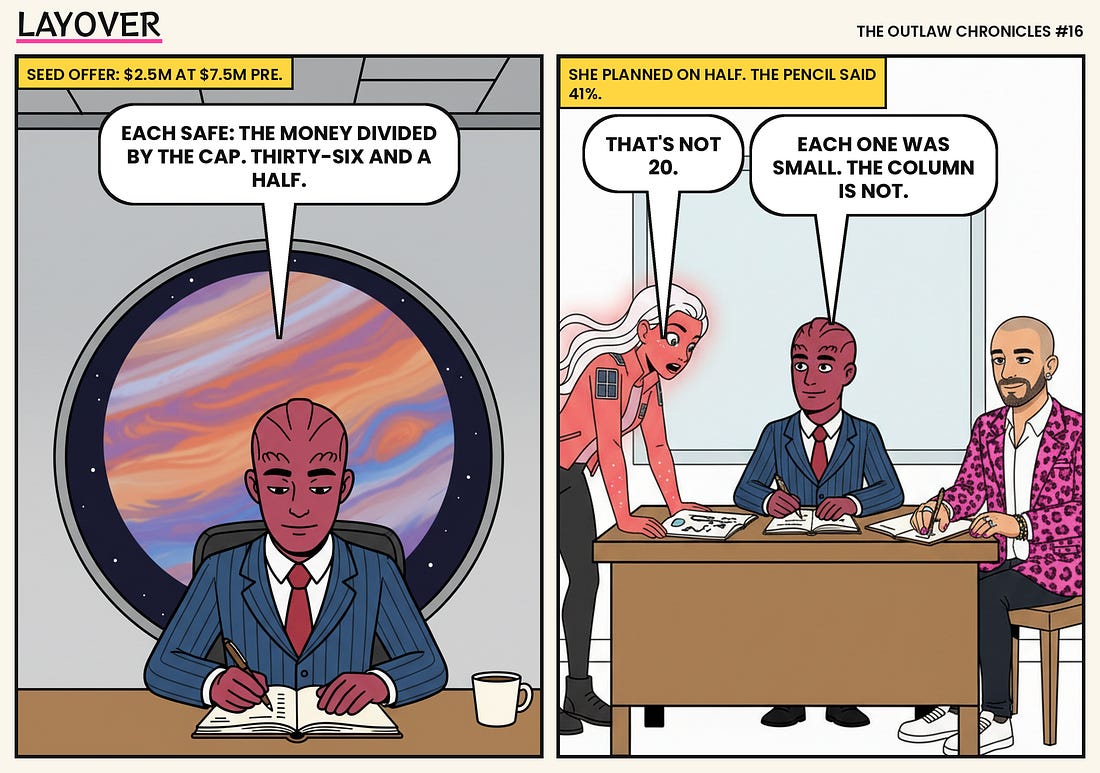
"Your SAFEs are post-money SAFEs," he said. "That is the standard one now. It makes each SAFE simple. You take the money and divide it by the cap." He wrote as he spoke. "Fifty thousand on a two million cap. Two and a half percent. A hundred thousand on two and a half million. Four percent."
He went down all ten. On the page it read $50,000 on $2 million, 2.5%, down to $300,000 on $6 million, 5%. The pen made the only sound in the room.
"And the part people miss," he said, without looking up. "A post-money SAFE keeps its slice. When you sign the next one, the earlier ones do not get smaller. The new slice comes out of you. Only you."
He drew a line under the column, added it, and turned the notebook around.
Thirty-six and a half.
Aura looked at it for a long time. Her glow dropped to about half power. "That's not 20."
"No," Delphi said, kindly. "You stopped counting at six. Six was twenty and a half. Then you said yes four more times."
"Each one was small," she said.
"Each one was," he said. "The column is not."
He did the rest on the next line. Aura keeps 63.5% going into the round. The round and the pool take 35% from everyone already there. 63.5% of 65% is 41.3%.
"I told my grandmother I'd keep half," Aura said.
I said what I always say at moments like this, which is not much. "Same company. Same people. Same kindness. You just never added the column."
Delphi tapped one more number. At a $10 million company, the gap between the half she planned and the 41% she had was 10.7 points. About $1.07 million, on paper, that she had given away one friendly percent at a time.
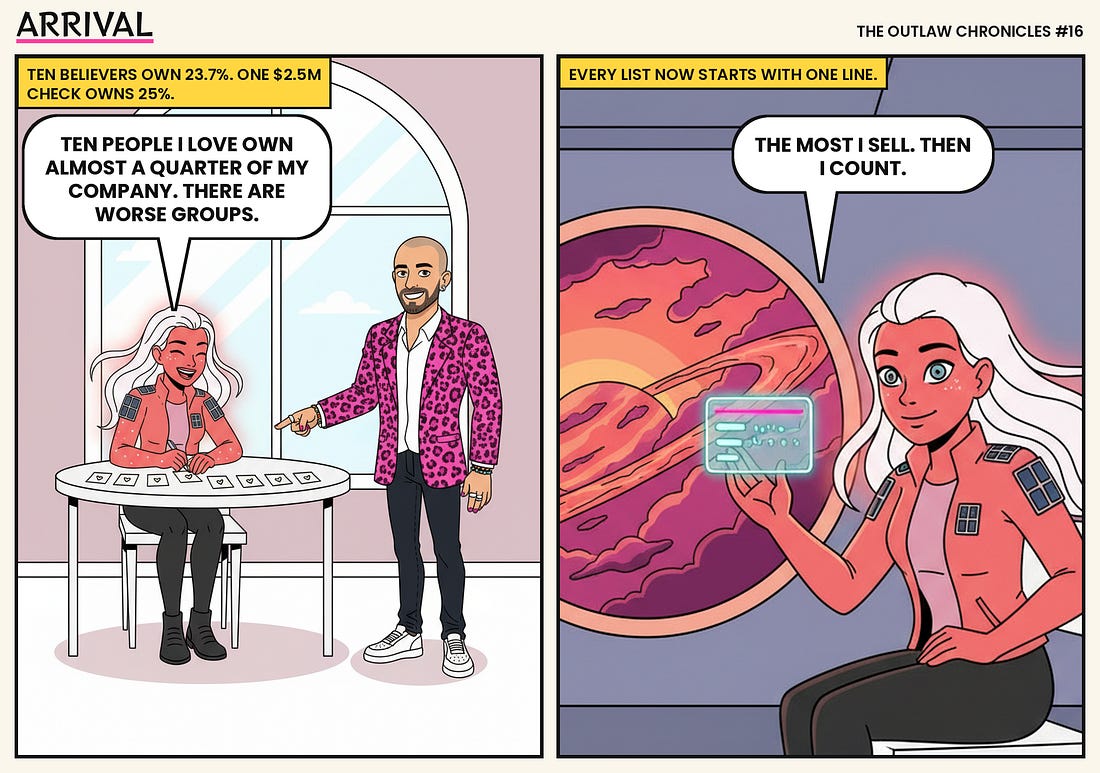
Then Aura did something I did not expect. She laughed. A real one, the kind that makes her hair flare. "Ten people I love own almost a quarter of my company," she said. "Honestly? There are worse groups."
She was right. After the round, the ten angels owned 23.7% together. Delphi's fund, with the biggest check in the room, owned 25%. Ten small yeses added up to almost the same weight as one $2.5 million check.
Arrival: The line at the top of the list
The line at the top of her list.
From the Guide: A budget is just a list that knows when to stop.
The round closed. 41% of a company worth $10 million, running on real money, with ten believers on the cap table and an investor who reads it by hand. That is not a disaster. It is just not the half she had promised her grandmother.
Aura wrote ten thank you notes. She meant every one of them.
Here is what happened, with the sci-fi taken out.
A post-money SAFE is honest. It tells you on the day you sign the slice it buys before your next round: the money divided by the cap. A round priced below the cap, or a discount, buys more. The trap is not in any one SAFE. It is in the stack. Every new SAFE comes out of the founder's slice. And none of them show up on the cap table as shares until the priced round turns them all into shares on the same day. Until then, they live in a folder, and the total lives nowhere.
Then the priced round takes its 35% from everyone already there, founders and SAFE holders alike. That part was always coming. The part Aura could have steered was the 36.5% she sold before it, one kind yes at a time.
Aura changed one habit. Her wrist list now starts with a line, before any names: the most she will sell before the next priced round. Every new yes gets added to the column the same day, before the money lands, and she checks it against that line.
The angels kept coming. She kept saying yes. Now she knows what each one costs.
The Blueprint
Three things to do this week.
From the Guide: Count the column while it is still short.
Add up your SAFE column today. List every SAFE and convertible note you have signed, with the amount and the cap. For each post-money SAFE, divide the amount by the cap. Add them up. For a convertible note or a pre-money SAFE the cap math is different, so put it in the tool or ask. Done looks like: one number, the percent your SAFEs own before your next round, written next to today's date.
Land your next round on top of it. Take that number, then take off the next round's likely new money and option pool (often 20% to 25% new money plus a 10% pool). Done looks like: the percent you will really own after your next round, in one line, next to the number you had in your head.
Write your line before the next yes. Decide the most you will sell on SAFEs before your next priced round, and put it at the top of your list. Before you sign any new SAFE, add it to the column and check it against the line. Done looks like: one percentage, written down, that the next check has to fit under.
Free resource: The SAFE Stack. Put in every SAFE you signed and see what you really keep after the round. See below.
The Free Resource
The SAFE Stack. Make your guess first: what do your SAFEs own, together? Then add each SAFE you signed, with its amount and cap, and land your next round on top. The tool shows what each check really costs, the yes that pushed you past your guess, and what you keep after the round. It scores your stack out of 100 and gives you three fixes for this week. Aura's ten SAFEs are loaded, so you can watch "about 20" become 36.5%. Runs in the browser, no sign-up.
Curious Corner
Three outside reads for anyone holding a stack of SAFEs.
SAFE User Guide: The accelerator behind the standard SAFE explains why each post-money SAFE owns about its money divided by its cap. It is where Delphi's pencil math comes from.
SAFE valuation cap: Mechanics, conversion, and founder ownership: Stripe on how a cap turns into a share price later, and why several SAFEs at low caps can pile up dilution you do not see until the priced round.
How founders calculate dilution impacts from SAFEs converting at different caps: Cake Equity works through examples where several SAFEs convert at their own caps. It is the column Aura never added, done slowly.
The Question
Without opening anything, what percent of your company do you think your SAFEs and notes own right now? Reply with just that number. Then open the SAFE Stack, do the real math, and tell me how far off you were. I read every one.
Writing this from Barcelona, where I said yes to one small pastry at the bakery and walked out with five. Next issue: an angel who wrote the first check into a company, and the one question she never asked. Now go count your column, then go say a few very well informed yeses. Pepe
The Outlaw Chronicles is for education only. Nothing here is legal advice. For the real thing, you know where to find me.