Mission Briefing
Alfi sold her company for $50 million. She owned 21% of it, which should have meant $10.5 million. The wire said $2.1 million. Nobody cheated and nobody made a mistake. Every number was in documents she had signed. This issue is about the line that gets paid before the founder does.
Venture Odyssey
Departure: The round that looked like a rocket
One extra word in the Series B.
From the Guide: Alpha Centauri. The closest star system to Earth, and the source of most of the galaxy's optimism, which it exports in bulk.
Alfi carries a tablet everywhere. Into board meetings, onto shuttles, to dinner, once into a swimming pool by accident. Sky blue skin, two slim silver antennae that twitch when a number goes up, and a faint pink halo around each iris that catches the light even in bright rooms. The tablet shows one chart. For five cycles, the chart only went one way.
She built the plumbing nobody sees. Mining colonies collect oceans of sensor data and have no idea who wants it. Alfi's company moves that data to the freight lines, insurers and weather relays who will pay for it, clean and on time. Not a product that gets you on a summit stage. The kind customers forget they are paying for until the day it goes down, which it never did.
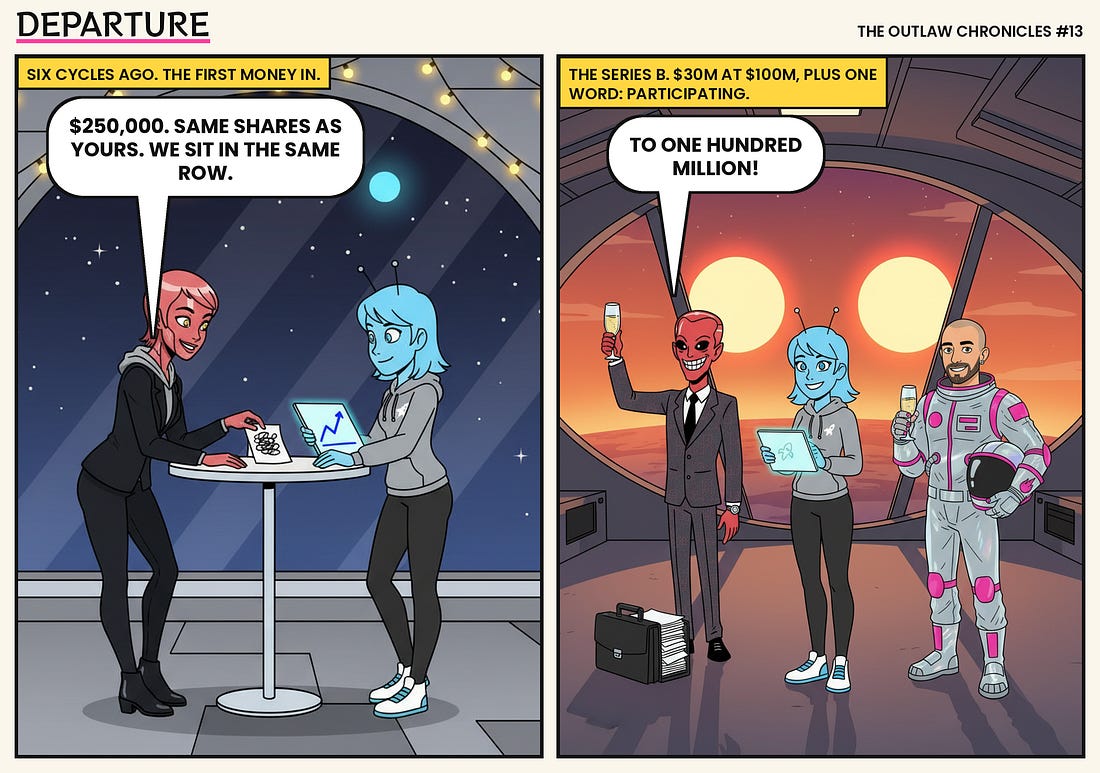
The first money came from Ange. Rose gold skin with the worn warmth of a device carried everywhere, a blazer over a founder hoodie she has not quite retired, and a habit of writing term sheets on cocktail napkins. Ange wrote one at a docking-bay mixer: $250,000 for common shares, the same class Alfi held. A lawyer turned the napkin into real paper a week later. "We sit in the same row," Ange said. "If you win, I win."
The Series A came from Perry. Warm amber skin, golden eyes with no white in them at all, and a rolodex hologram that drifts behind him like a loyal moon. Perry introduced two customers before he wrote his check. $12 million, for preferred shares with a 1x non-participating liquidation preference. In plain words: in a sale, Perry gets his money back first, or he gives up that place in line and takes his percentage like everyone else. Whichever is bigger. Never both.
Then the Series B. Reti, from Zeta Reticuli. A head taller than everyone at the table, crimson lacquered skin, a smile with too many teeth, and a briefcase that never quite closes because of all the term sheets inside. Reti offered $30 million at a $100 million valuation after the money came in (converted that morning at the interstellar exchange, before the Reticulan markets did whatever they did that week). His preferred came with a 1x liquidation preference too, paid before anyone else's, with one extra word in front of it. Participating.
Alfi's lawyer flagged the word. Alfi asked if it was normal. The lawyer said it was common in rounds that size, which was true. Alfi looked at the $100 million, then swiped back to her growth chart.
She signed at a docking-bay reception with a view of two suns. Reti gave the toast. Everyone clapped. The tablet glowed in her hand like a third, smaller sun.
Layover: Forty-two million in line
$42M in line ahead of her.
From the Guide: On most worlds, the queue is a social contract. In a sale, it is a legal one.
Two cycles after the Series B, the market cooled. Not a crash. A long, polite chill. Two larger platforms started bundling data delivery for free, and Alfi's growth fell from 70% a year to 25%. The company was healthy. It was no longer a rocket. Raising again would have meant a lower price than Reti paid, and nobody on the board wanted to say the words "down round" out loud.
Then a logistics conglomerate three systems over sent a holographic transmission with an offer. $50 million, cash, for the whole company. The board met and liked it. Reti liked it. Perry liked it too, with one caveat, which he delivered privately that evening.
"Before you say yes," Perry said, "run the waterfall. The headline and your number are not the same thing."
Alfi ran it in her head instead. She owned 21% of the company. 21% of $50 million is $10.5 million. Six cycles of work, ten and a half million. She pinged her family. She did not open a model.
Three days later the acquirer's lawyers sent the funds flow memo, the document that says, line by line, who receives which part of the purchase price. Alfi read the last row and sent me a ping on the trade-net with one word in it. "Come."
I took the shuttle. Real space, not a transmission, because some conversations need a table. Her company kept a small glass meeting room on a station above Alpha Centauri, the kind where both suns set twice an evening. I was in my pink leopard blazer. Ange was already there, folding and unfolding a napkin. Alfi had the tablet face down on the table, which for Alfi is a white flag.
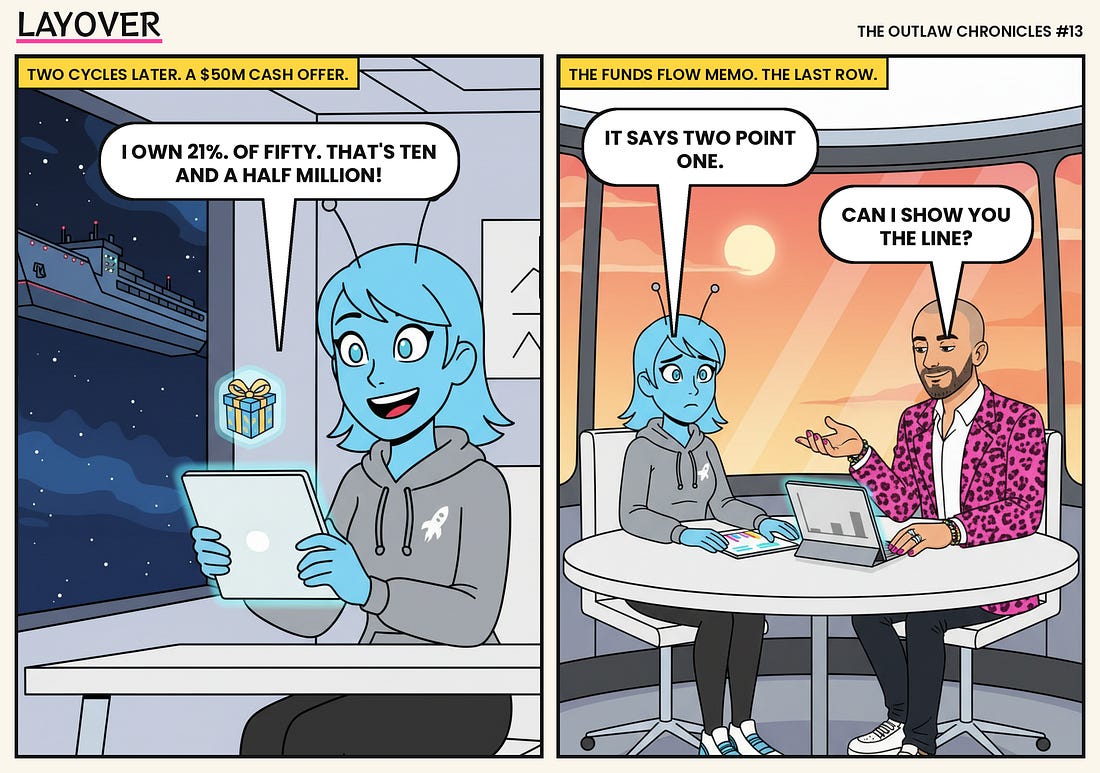
"It says two point one," she said. "Two point one million. I own twenty-one percent. Of fifty. That's ten and a half."
"In a room where nobody stands in line ahead of you, it is," I said. "Can I show you the line?"
She turned the tablet over.
"Reti first," I said. "His preferred gets paid before anyone's. One times his money. $30 million. That leaves $20 million."
"Then Perry."
"Then Perry, and Perry gets a choice. Take his $12 million back, or convert to common and take his 20% of what's left. 20% of $20 million is $4 million. He takes the $12 million. Anyone would."
Her antennae were doing the arithmetic. "That leaves eight."
"$8 million. Now everyone in the common pool splits it by percentage. You, 21. Ange, 6. Your team's options, 23. And Reti, 30."
"Reti already got paid."
"That's the word you swiped past. Participating. He takes his money back, then shares in what's left as if he had never taken anything. Eighty points split $8 million. $100,000 a point. You have 21 points."
"Two point one," Alfi said.
Nobody said anything for a while. Outside, the second sun went down.
Ange broke it. "$600,000," she said, reading her own row. "For a quarter million, six cycles ago. Same row as you. I told you we would be."
"And the team?" Alfi asked.
"$2.3 million across forty people, before exercise prices."
She put both palms flat on the table, the way people do on a ship when it turns. "Did anybody do anything wrong?"
"No," I said. "Reti asked for what funds like his ask for, and wrote it down. Perry took the founder-friendly version and is getting exactly what it promised. Your lawyer flagged the word. You signed with your eyes open, at $100 million. Nobody ran the math at $50 million."
"What would it look like without the word?"
"Non-participating? Reti takes his $30 million and steps out of the pool. Perry takes $12 million. The $8 million splits across fifty common points instead of eighty. You'd get $3.36 million."
"So one word cost me $1.26 million."
"One word cost you $1.26 million. The other $7.14 million is the line itself. $42 million of preferences stood in front of you on a $50 million sale."
"Can I say no?"
"Check who has to approve a sale in your documents. Then ask what the alternative is. A new round at a lower price adds a fresh layer to the top of the line, and new money in a down round rarely asks for less."
She looked out at the dark side of the station for a long time. "Then the team sees this before I sign," she said. "All forty. From me. Not from a memo."
Arrival: The bottom of the tower
Same documents. Half the price.
From the Guide: Everyone toasts the headline. Only the founder reads the last row.
She signed. The conglomerate's wire arrived on a Thursday. Reti's fund received $33 million on a $30 million check and sent a gracious note. Perry got his $12 million back and sent a better one, the kind that offers introductions for whatever comes next. Ange framed the napkin. Alfi walked all forty people through their real numbers on a Monday morning, row by row, and two of them told her she was the first boss who ever had.
Her row said $2.1 million. A lot of money. Not the money she thought she had.
Now the mechanism, plainly. Every priced round adds a layer of preferred stock, and every layer comes with a place in line. In a sale, the line gets paid in order, and common stock (founders, angels on common, employees) stands at the back. Non-participating preferred takes its money back or its percentage, whichever is bigger. Participating preferred takes its money back and then its percentage too. A cap on participation switches that second bite off once the investor has received a set multiple of its money, usually two or three times.
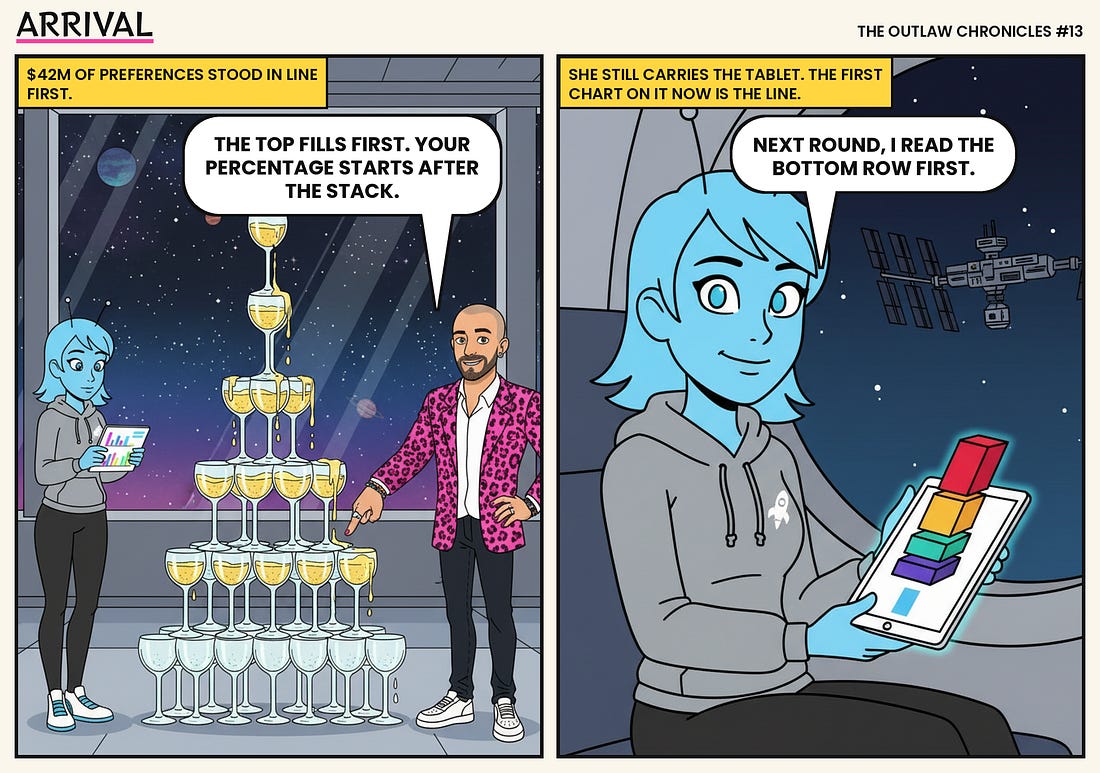
Think of it like a champagne tower at a wedding. The glasses at the top fill first. Only the overflow runs down to the next level, and only that level's overflow reaches the bottom. Pour enough and every glass fills. Pour barely more than the top rows can hold, and the bottom row gets a splash while everyone above it raises a toast.
The size of the pour is the whole story. At $100 million, the same stack hands Alfi $14.7 million. Reti still takes his $30 million first, but Perry converts, because 20% of the $70 million left beats his $12 million, and that $70 million splits across all one hundred points. At $50 million, the stack hands her $2.1 million. Same documents. Same signatures. Half the price, one seventh of the money.
Your percentage only tells you what you get once the sale price is well above the stack. Below that, the stack decides. So add up every preference ahead of you, write the total on one line, and keep it next to your last valuation. That is the number a buyer has to beat before your percentage means anything.
Alfi still carries the tablet. The first chart on it now is the line.
The Blueprint

Three things to do this week.
From the Guide: Your percentage is a promise. The stack decides when it is kept.
Write down your preference stack today. For every class of preferred on your cap table, list the amount invested, the multiple, participating or non-participating, any cap, and the order in which each class gets paid. Done looks like: one table, one row per class, with the total of every preference ahead of common written on the last line.
Run your own number at three sale prices. Take half your last post-money valuation, your last post-money valuation, and double it, and walk the line in order for each one. Done looks like: three rows showing what you, your angels on common and your option pool actually take home at each price.
Price the word "participating" before your next term sheet is signed. If the lead asks for participating preferred, model what it costs you at a realistic sale price, then counter with non-participating or with a cap at 2x or 3x, and offer something else in trade. Done looks like: a written counterproposal with the modeled dollar difference next to it, sent before you sign.
Free resource: The Anti-Dilution Clause Decoder. See what every class on your cap table owns when the price moves, the other half of the stack. See below.
The Free Resource
The Anti-Dilution Clause Decoder. The stack has two halves: what each class takes home in a sale, and how much of the company each class owns when the next round prices lower. The Decoder handles the second half. Paste your clause and see the math walked out, class by class. Runs in the browser, no third-party sign-ups.
Open The Anti-Dilution Clause Decoder.
Curious Corner
Three outside reads for anyone who has only ever toasted the headline number.
Term Sheet: Liquidation Preference: Brad Feld's plain-words walk through the clause that paid Reti twice. Full participation, capped participation and non-participating, side by side. Read the capped version and price what Alfi could have countered with.
Terms of VC endearment: Forget the valuation, what's the deal?: A founder runs three term sheets through the same exit and gets three different founder payouts. The higher valuation does not win by default. It is Perry's advice in one page: run the waterfall before you celebrate.
Squaring Venture Capital Valuations with Reality: William Gornall and Ilya Strebulaev value 135 unicorns share class by share class and find reported valuations about 50% above fair value, with common stock overvalued most. The $100 million Alfi kept repeating was the price of Reti's shares, not hers.
The Question
Think about the night your last round closed, the toast, the valuation everyone repeated. If someone offered half that number tomorrow, do you know what would land in your account, and which person on your team you would have to show their row to first? Hit reply, I read every one.
Writing this from Barcelona, where the cafe downstairs stacks its glasses in a pyramid on the bar, and I can no longer look at it without counting the bottom row. Next issue: three investors, one term sheet, and the side letter nobody else knew about. Now go find out who stands in line ahead of you. Pepe
The Outlaw Chronicles is for education only. Nothing here is legal advice. For the real thing, you know where to find me.