


Mission Briefing
Ori closed his first priced round with three investors on one term sheet. Same price, same shareholders agreement. Fourteen cycles later, a bridge note asked him to list every side letter, and his investors learned the smallest check had a board observer seat and monthly numbers. This issue is about the deal behind the deal.
Venture Odyssey
Departure: One term sheet, three signatures
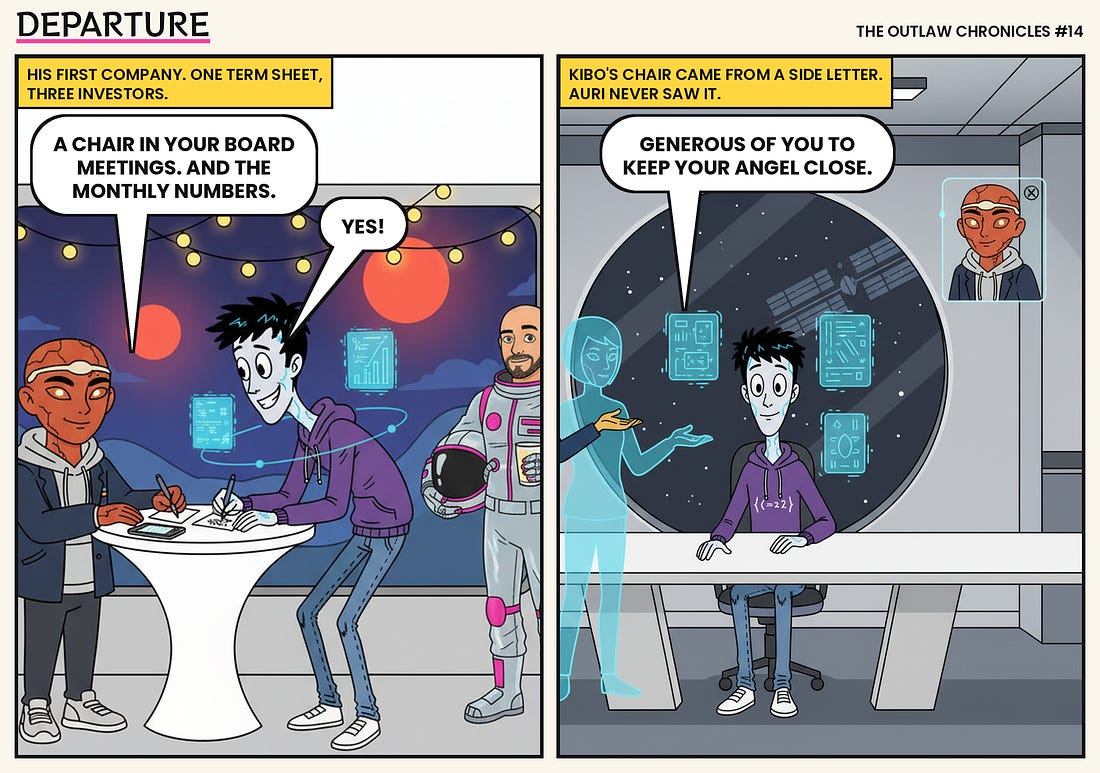
One term sheet, one price, three investors.
From the Guide: The Orion Nebula. A stellar nursery, where new stars form faster than anyone can name them, and nobody stops to read the paperwork.
This was Ori's first company. Impossibly thin limbs, eyes twice the size you expect, hair that ignores gravity, and faint blue circuits glowing under the skin at his wrists. Three small code windows orbit his head at all times, and he reads them the way other people check the weather. Business conversations make him slouch. The fastest way out of one, he learned early, is to say yes.
The company made scheduling software for ship-repair yards across the Orion belt. Which hull goes into which bay, which welding crew, which cycle. Not a product anyone puts on a summit stage. The kind of product a yard manager opens at six in the morning and never closes.
He ran the fundraise like a product too. Pipeline in one code window, every conversation scored, every follow-up timed. It worked. He closed a $3 million seed round, priced, at $9 million before the money (converted that morning at the interstellar exchange, before the Aurigan markets did whatever they did that week). One term sheet. One price per share. One shareholders agreement. Three investors.
Auri led with $1.5 million from an impact fund three systems over. Honey gold skin without a single pore, a face so evenly proportioned it takes you a second to notice, and a warmth that arrives exactly on time, every time. She took the one investor seat on a three-seat board. Her fund also sent "our standard side letter," two pages, mostly about how the company would report impact numbers to the fund's own investors. Paragraph four said that if the company ever gave another investor in this round better or extra rights, it would tell Auri's fund within ten business days and offer the same. Ori's lawyer called it boilerplate. It was.
Delphi put in $1 million. Deep wine red skin, forehead ridges that deepen when he is thinking, a leather notebook and an old pen, and not one hologram anywhere on his person. "I don't do side letters," he told Ori. "If I need something, it goes in the main documents, where everyone can read it." He signed exactly what the term sheet said.
Kibo put in $500,000. Terracotta skin, copper flecks in his brown eyes, a flag patch on the hoodie under his jacket, and two phones, one in each hand, both lit. He runs an angel network that stretches across half the diaspora, and he answers both phones in the same breath. The shareholders agreement gave information rights only to Major Investors, defined as anyone who put in $750,000 or more. Kibo's check sat $250,000 under the line. The main documents gave him shares and nothing to read.
So at the closing reception, on a docking bay with a view of two suns, he put both phones face down, for once, and wrote two asks on a cocktail napkin. A seat in the board meetings as an observer. The monthly numbers. "I learn by watching," he said. "I help by knowing."
Ori said yes. Kibo really could help, and everyone says yes at a closing reception. The next morning, Kibo's counsel turned the napkin into a three-page side letter. Ori's lawyer read it, said it was within market, and Ori signed it in a code window between two customer calls.
Three investors. One term sheet. Nobody at the table had read all three sets of paper, because nobody at the table had been sent all three.
Layover: Page nine
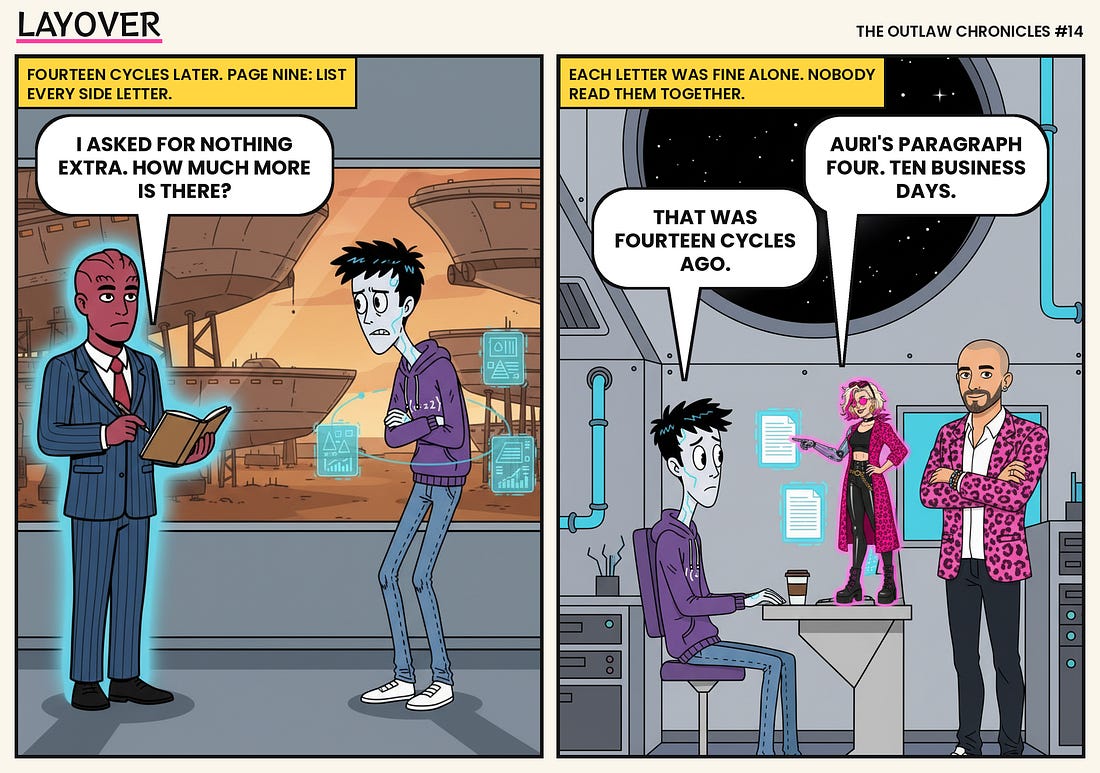
Page nine asked for every side letter.
From the Guide: A side letter is a private conversation, written down. Private conversations have a long history of being read aloud.
Board meetings happened by holographic transmission, once a quarter. Ori, his co-founder, Auri. And in the corner, a fourth tile, usually muted: Kibo. Auri assumed he was the founder's guest, which boards allow all the time. Once she even said, "Generous of you to keep your angel close." Ori smiled. It did not occur to him that there was anything to correct.
The numbers moved on two clocks. The shareholders agreement sent Auri and Delphi a quarterly pack within 45 days of the quarter's end. Kibo's side letter sent him monthly accounts within 15 days of each month's end. So January's numbers reached Kibo in the middle of February, and reached Delphi in the middle of May.
Kibo used them well. He spotted a slow month at two yards in the outer belt and introduced Ori to a fleet operator from his network who filled both. Nobody was hurt. Nobody was even close to hurt.
Fourteen cycles in, the market for repair-yard software got crowded. Ori needed an $800,000 bridge to reach the next round. A bridge is exactly what it sounds like: a small, quick round of money that carries the company across to the next big one. Delphi offered to lead it, which is exactly the kind of thing Delphi does. His counsel sent a convertible note, which is a loan that turns into shares at the next round instead of being paid back. Attached to it was a disclosure schedule, the list at the back of a deal where the company writes down everything the investor deserves to know before signing. Page nine had one line that needed filling in: list every agreement between the company and any investor that grants rights not found in the shareholders agreement.
Ori listed two side letters. He attached both. The bridge also needed Auri's consent under the shareholders agreement, so Auri's counsel read page nine too.
Delphi sent a holographic transmission that evening, notebook open. He was calm, which was worse than angry.
"I asked you for nothing extra," he said, "because I assumed nobody had anything extra. How much more is there?"
Ori called me. I happened to be two docks over that cycle for another client, so I walked. Real space, his office on the repair ring, a little after eleven at night, cold coffee on the desk. I was in my pink leopard blazer, which on a repair ring at midnight is a statement nobody asked for. He had the two side letters open in two of his code windows. Janis, my chief of staff, was already on his desk as a hologram the size of a coffee cup, and she had found the line before I took my jacket off.
"Read Auri's first," Janis said. "Paragraph four."
He read it aloud. Better or extra rights to any other investor in this round. Notice within ten business days. Offer the same.
"When did you sign Kibo's letter?"
"The morning after closing."
He did the math before I could. The circuits at his wrists dimmed. "So the ten business days ran out about fourteen cycles ago."
"Give or take," I said. "If it helps, I have seen this exact page nine more times than I can count."
"Is it bad?"
"It's a promise in writing that wasn't kept. Not a crime. Lawyers call it a breach of a covenant, and a covenant is just a formal promise inside a contract. Auri's fund can waive it, or it can use it. And you need their consent on the bridge this month, so they'll be deciding which in the same week."
"Kibo didn't do anything wrong."
"No. His check couldn't buy those rights in the main documents, so he asked for them on the side, and you said yes. That's how side letters are supposed to work. The problem isn't his letter or hers. It's that the two letters never met each other. Each one got read on its own, which is how almost everyone reads them."
He scrolled to Kibo's observer clause. I asked three questions.
"Does it say anything about confidentiality?"
"No."
"Can the board ask him to leave the room when it discusses something he has a conflict on, or something privileged?"
"No."
"When does it end?"
He read it twice. "It doesn't."
"So if he sold every share tomorrow, he'd still have a chair in your boardroom. A director owes legal duties to the company. An observer, someone who sits in on board meetings without a vote, usually owes only what the paper says. And this paper is very relaxed."
His code windows flickered, one by one. "I gave him the chair on a napkin."
"Technically on three pages," I said. "But in fairness to the napkin, it said exactly what everyone meant."
He laughed for the first time that night, the tired kind.
Auri sent her own transmission the next morning, smiling exactly as much as she meant to, which is how Auri says reasonable.
"We're not upset about the observer," she said. "We're upset about learning it from Delphi's disclosure schedule. We'll take the monthly numbers, starting now, and every month we missed. And before we consent to anything, that observer seat gets a confidentiality clause and an end date."
Arrival: Three deals, one table
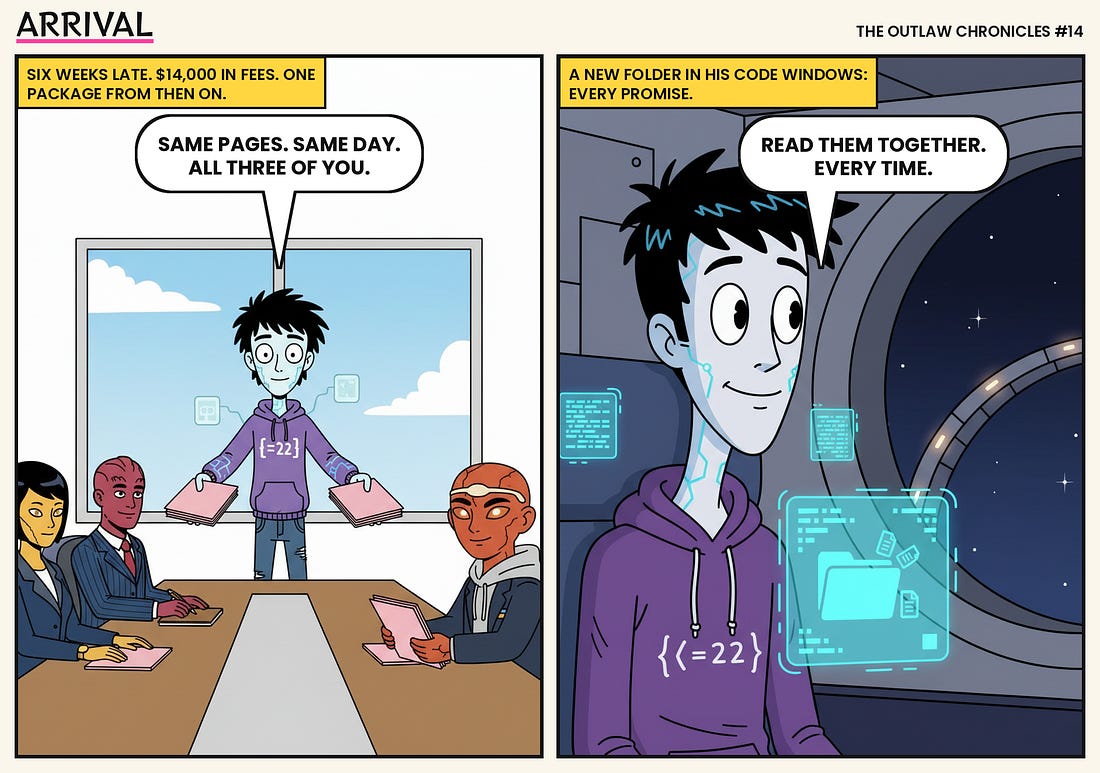
One package. Same numbers. Same day.
From the Guide: Every deal has two layers. The one everybody signs, and the one somebody signs. Read them in the same room.
It took six weeks. Kibo agreed to let both side letters be shared with all three investors before anyone asked him twice. "I'd rather be the investor everyone knows about," he said. He signed an amendment: a confidentiality undertaking, the board's right to excuse him for privileged or conflicted items, and an end to the seat once he holds less than half of his original shares. Auri's fund took the monthly numbers under its side letter and waived the missed notice in writing. Delphi had no side letter and no clause to point at. Ori gave him the monthly numbers anyway.
From then on there was one information package. Same pages, same day, all three investors. The bridge closed six weeks late, with $14,000 in legal fees, paid by a company that had raised $800,000 to buy time.
Here is the mechanism, now that the story has earned it. A side letter is a separate agreement between the company and one investor, signed alongside the main documents, that adds or changes rights for that investor only. It is legitimate and common. A most favored nation clause, MFN for short, is a promise that if another investor gets better terms, you hear about it and can take them too. Each document can be perfectly fine alone. The trouble starts in the space between them, because nobody's job is to read them together unless you make it somebody's job.
Think of it like a card game where three players buy in for the same stake, and one of them, by private arrangement with the dealer, sees each card a few seconds early. He may never use it. He may be the most honest player at the table. The moment the others find out, the game is over, and nobody remembers that he was honest.
This cuts both ways on the cap table. If you are the founder, every side letter you sign is a promise to one investor that may trigger a promise to another, so keep them in one place and read them together. If you are the investor, ask before closing whether anyone else has a side letter. Delphi's mistake was the kindest one in the story. He assumed.
Ori still keeps three code windows in orbit. One of them is a folder now, called "Every promise." It has three files in it, and all three investors have read all three.
The Blueprint
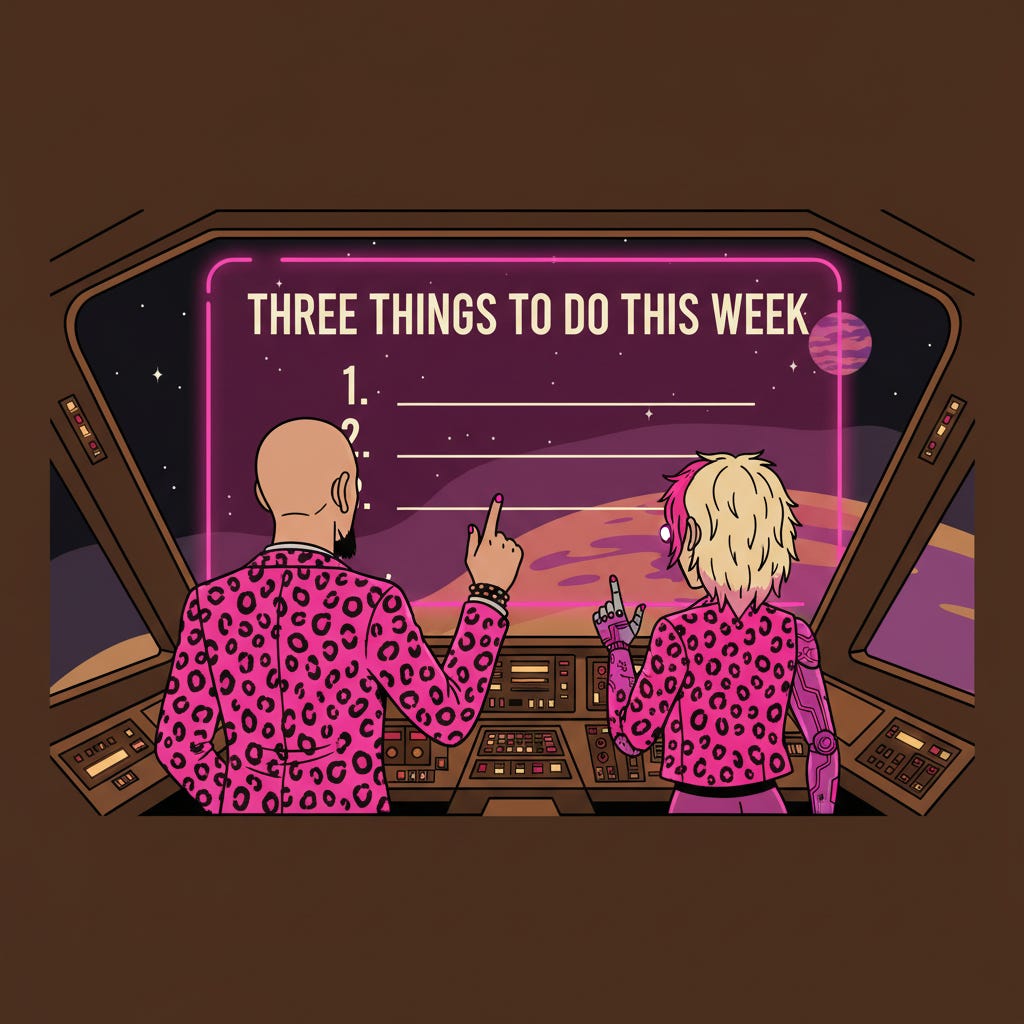
Three things to do this week.
From the Guide: A side letter is a clause that lives in a different house. Visit it.
Build a side letter register today. List every side letter your company has signed, with the investor, the date, each extra right it grants, and when each right ends. Done looks like: one page, saved next to your shareholders agreement, with no right on it marked "ends: never" unless you chose that on purpose.
Read every side letter against every MFN clause, in both directions. For each side letter, check whether it gives rights that another investor's MFN covers, and whether the notice that MFN requires was ever sent. Done looks like: a written note per side letter naming the MFN it triggers, the date notice went out, and what each investor elected.
Put three limits on every board observer seat before you sign it. A confidentiality undertaking, the board's right to excuse the observer for privileged or conflicted items, and an end date tied to how many shares the observer still holds. Done looks like: every observer right on your register carries all three limits, in writing, signed by the observer.
Free resource: The SHA Gap Checker. Ten questions to find the gaps in your shareholders agreement, including the rights that live outside it. See below.
The Free Resource
The SHA Gap Checker. Information rights, observer seats, consent rights, the clauses that point at other documents. Answer ten questions and see where your shareholders agreement has gaps, before a disclosure schedule finds them for you. Runs in the browser, no third-party sign-ups.
Curious Corner
Three outside reads for anyone who signed something on the side this year.
A Sharper Focus: Exploring VC Side Letters: Lawyers at Troutman Pepper Locke sort side letter rights into three groups, from low-impact information and observer rights to rights that change what other investors get. One of their examples is close to Kibo's: an investor below the information-rights threshold asking for those rights in a side letter anyway.
The Board Observer: Considerations and Limitations: Two Skadden partners on why an observer owes no fiduciary duties and only the confidentiality the contract gives them, and why privileged advice in front of an observer can lose its privilege. Two of the three questions I asked Ori at midnight on the repair ring start here.
Primer: Side Letters in Private Equity and Venture Capital Funds: Cooley's primer is written for funds, but the MFN mechanics are the same ones in Auri's paragraph four. Who qualifies, what gets disclosed, and how long an investor has to elect the better terms.
The Question
Think about the last round you closed, from either side of the table, and the moment the side letters were sent around for signature. Did every investor in that round know the others had one, and would you be comfortable reading all of them aloud at your next board meeting? Hit reply, I read every one.
Writing this from Barcelona, where my desk currently holds three coffee cups and one data room that nobody has read in the same order twice. Next issue: Sirix, who knew for six months that something had to change, and what each day of delay cost. Now go read the paper you signed on the side, before someone else reads it for you. Pepe
The Outlaw Chronicles is for education only. Nothing here is legal advice. For the real thing, you know where to find me.