Mission Briefing
Delphi had built a profitable company without raising a cent of outside money. No investors. No liquidation preferences. No board seats to negotiate. His cap table was clean: two columns, two names, two percentages. Then his spouse filed for divorce. In a community property jurisdiction, equity acquired during marriage is potentially marital property. Nobody had mentioned that column existed. This issue is about the one cap table conversation nobody has until they need a lawyer for a different reason.
Venture Odyssey
Departure
: The patient builder
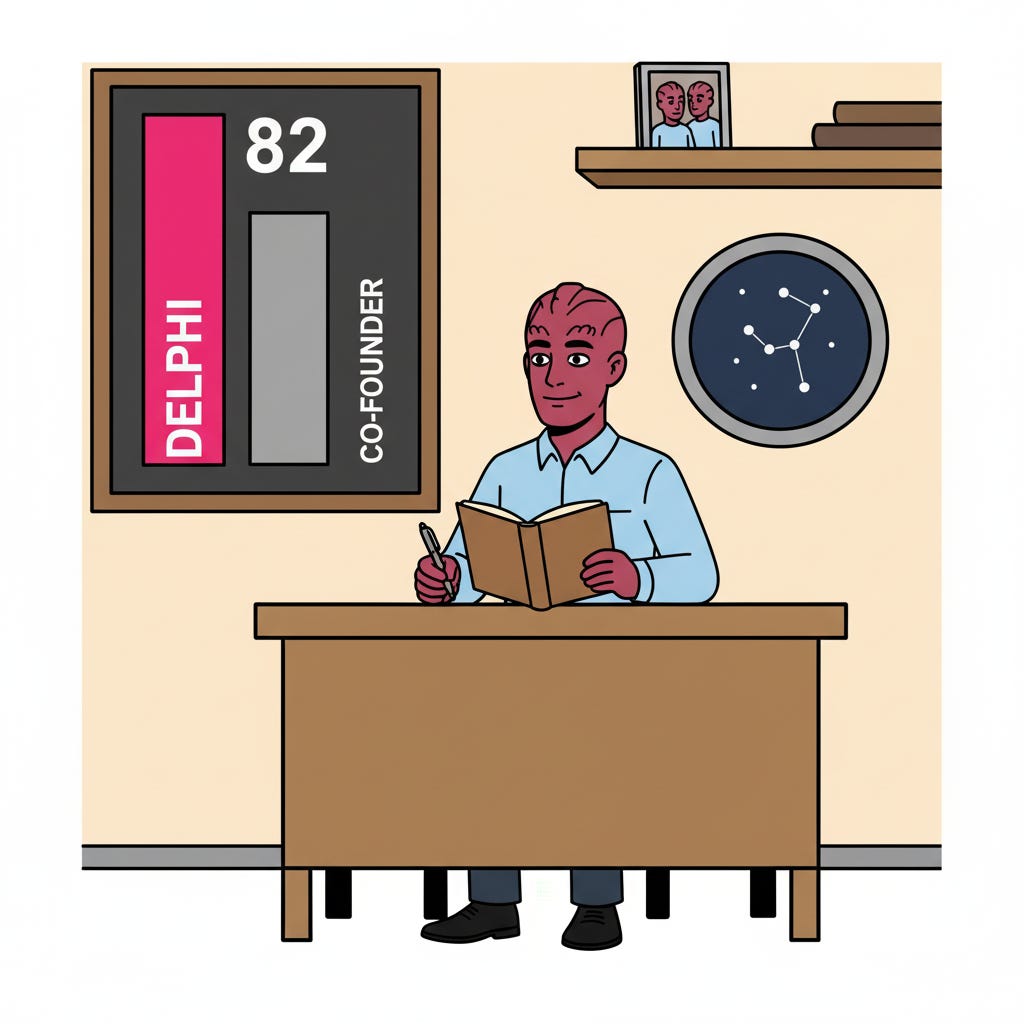
Delphi is from Delphinus, a small and often overlooked constellation that sits near the edge of the Summer Triangle. People from Delphinus tend to be patient in a way that other founders find slightly alarming. Delphi has forehead ridges that deepen when he is thinking, which is most of the time. He carries a leather notebook. He has never owned holographic technology of any kind. He was profitable since month eight of the company's life, which he mentions approximately never, because he considers it a threshold rather than an achievement.
He had built a supply chain analytics platform for food and beverage companies. The product worked. The customers renewed. The team was small and stayed. He had co-founded it with a technical partner who had since taken a reduced role and received a partial buyback. Delphi now held 82% of the company. He had been offered venture money twice and declined twice on the grounds that the capital was not needed and the governance it came with was not worth the price.
He had also, at the age of thirty-one, gotten married. This detail appears in his company documentation nowhere, which is to say it appears exactly as prominently as most founders consider it should appear in their company documentation, which is to say not at all.
His spouse worked in architecture. She was talented and ambitious and entirely unconnected to the supply chain analytics business. The company was his world. The marriage was a different world. For seven years these worlds ran in parallel without intersecting in any legal sense that Delphi had considered.
He did not think about the cap table and the marriage in the same sentence. Nobody had asked him to.
Year seven was difficult. The parallel worlds began to exert pressure on each other. He was working longer hours as the company scaled. His spouse had taken a partnership role that required significant travel. The texture of the relationship changed in the slow and irreversible way of things that have been under pressure for long enough.
He filed for divorce on a quiet Tuesday in October. He told his CFO the following week, not because it was relevant to the CFO's job but because they had worked together for four years and Delphi thought he deserved to know.
His CFO, who had seen several of these situations at previous companies, asked one question. "Is the company in a community property jurisdiction?"
Delphi looked at him for a moment. "What does that mean for the company?"
Layover
: The spreadsheet with no column for this
The jurisdiction in which Delphi had incorporated and in which he lived was a community property state. Community property law holds that assets acquired during the course of a marriage are jointly owned by both spouses, regardless of whose name appears on the title, the account, or the cap table. This includes business interests acquired during the marriage.
Delphi had incorporated the company two years before he got married. The shares he held on the day of the wedding, approximately 40% of a company that was then worth very little, were his separate property. The shares he had acquired since then, through option exercises, buybacks of his co-founder's unvested equity, and other mechanisms, had been acquired during the marriage.
His family law lawyer walked him through the analysis on a Thursday afternoon. I was on the call because Delphi had asked me to sit in, and I sat in the way you sit in on something when you already know roughly what is going to be said and you are there to help the person next to you hear it clearly.
"The shares you held before the marriage date are your separate property," the lawyer said. "We can trace those clearly. The shares you acquired after the marriage date are presumptively community property. That means your spouse has a potential claim to 50% of those shares."
Delphi's notebook was open in front of him. He was not writing in it. He said: "How many shares did I acquire after the marriage?"
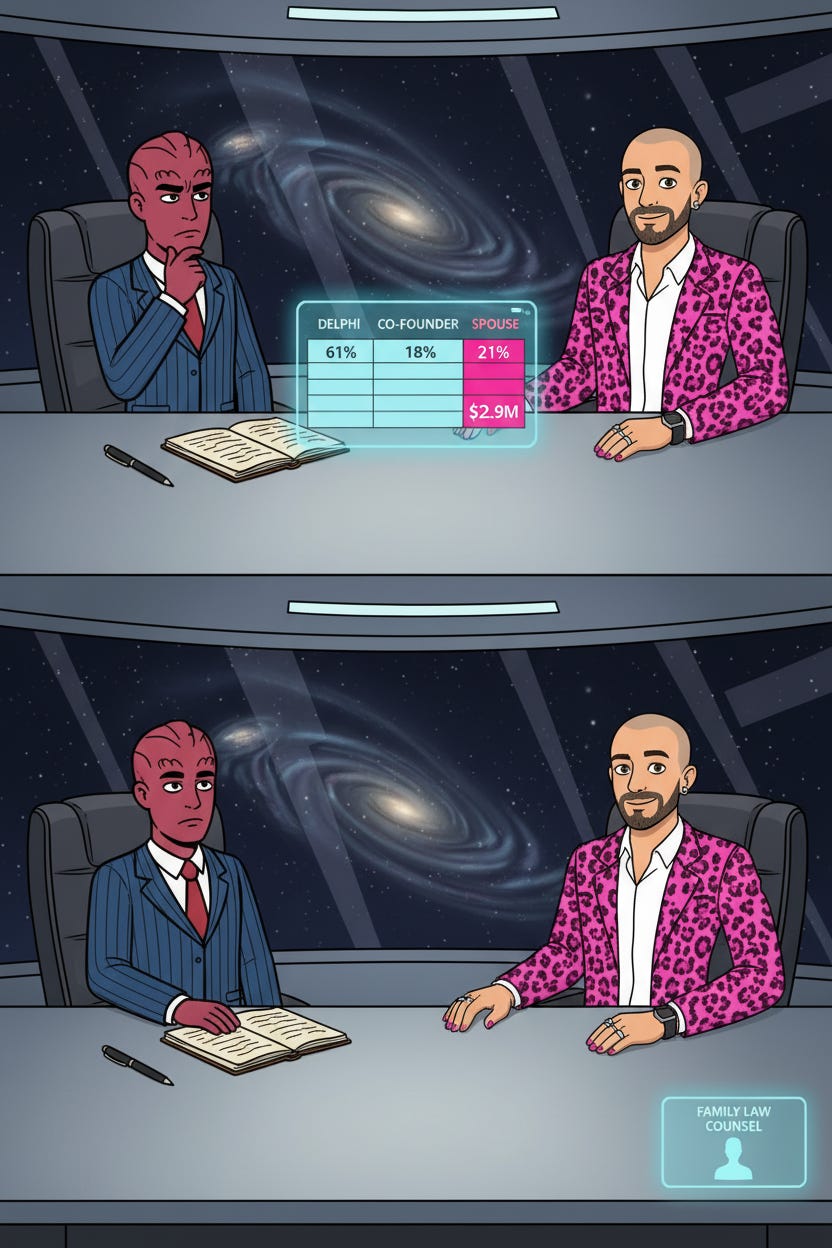
The lawyer looked at his notes. "Based on the cap table history you shared, approximately 42% of your current 82% stake was acquired during the marriage. Your spouse's potential community property interest is approximately 21% of the company."
Delphi said: "She has never been involved in the company."
"That is not the legal question. The question is when the assets were acquired and whether they are characterised as community or separate property. Community property regimes do not require contribution to the business. They require marriage at the time of acquisition."
"What does 21% of the company mean in dollar terms?"
The company had been valued informally, by a third-party firm, at $14 million the previous year. 21% of $14 million.
Delphi set down his pen.
"Is there anything to be done?" he said.
"There are several options," the lawyer said carefully. "The first is a negotiated settlement in which your spouse accepts a different asset in exchange for her community property interest in the company shares. The second is a buyout, in which the company or you personally purchase her interest. The third is a valuation dispute, in which you argue that the shares are worth less than the informal valuation. The fourth is that the court orders a partition of the shares, which is extremely disruptive to a private company and something most courts are reluctant to do, but it is available."
I said one thing before the call ended. "The time this would have been much cheaper to address was before the marriage. A prenuptial agreement that addressed the company shares as separate property, or a marital property agreement that established clear characterisation rules, would have made this analysis cleaner. These agreements are enforceable in most community property states if they are properly drafted and disclosed."
Delphi looked at me for a moment. Then he said: "No one mentioned that."
He was right. No one does. The incorporation lawyer does not mention it. The accountant does not mention it. The investor, if you have one, is focused on your cap table, not your marriage. The financial advisor, if you have one, may mention it in the context of estate planning, but most founders at early growth stage do not have a financial advisor. The gap between "this is a legal reality" and "this is a conversation someone had with you before it mattered" is the size of a jurisdiction and a seven-year marriage.
He settled with his spouse over the following eight months. She received a combination of cash and a buyout of her community property interest at an agreed valuation. The total cost was significant. The company was not destabilised. Delphi remains the CEO.
He told me, after the settlement closed, that the thing he thought about most was the gap between the complexity of the cap table conversation he had with investors, which had never happened because there were no investors, and the simplicity of the conversation he had never had about what the cap table meant inside his marriage.
"It was the same spreadsheet," he said. "It just had a column I did not know existed."
Arrival

: The intersection nobody draws
Every founder who gets married after incorporating a company, or incorporates a company after getting married, is creating a potential intersection between family law and corporate law. These two bodies of law almost never communicate with each other until the moment they are forced to, which is usually a divorce proceeding.
The intersection works differently depending on the jurisdiction. Community property states and countries, which include California, Texas, Spain, France, and several other major founder ecosystems, create a presumption that marital assets are jointly owned. Common law jurisdictions, which include most of the UK and many other markets, use different rules. The applicable law is usually the jurisdiction of residence at the time of divorce, not the jurisdiction of incorporation. A Delaware company with a founder living in California is subject to California community property law in a divorce proceeding.
The fix, like most fixes, is much cheaper before the problem exists than after. A prenuptial agreement that properly characterises the founder's company shares as separate property, including shares acquired during the marriage through option exercises or buybacks, is a document that takes a few hours of legal time to prepare. Done before the wedding, disclosed honestly to both parties, it creates a clear record of what was agreed. This is not a romantic document. It is an accurate one.
Think of it like an insurance policy for a risk nobody plans to face. The premium is modest. The coverage is specific. You buy it not because you plan to need it but because the cost of needing it without having it is very large.
The cap table has a column for community property. The column exists whether or not you have looked at it.
Three things to do this week

Find out which rules you live under. Where you live when you divorce decides it, not where the company is registered. California, Texas, Arizona, Nevada, Washington, Spain, France, Mexico and a long list of others are community property: what you built while married splits in half by default. Most other US states, England, Kenya, Nigeria, Canada, Australia are equitable distribution: a judge draws the line. Done looks like: one line in your founder file naming your jurisdiction and its regime.
Map your shares against your wedding date. Shares you held on the day you married are usually yours. Shares you picked up after, through option exercises, buybacks of a co-founder's stake, or new grants, are the ones on the table. Done looks like: a written note from a family law lawyer showing which slice of your holding is separate and which is marital.
Get the document that moves the column. Not married yet: a prenup that names the company shares, including the ones you will acquire later, as separate property. Already married: ask whether a postnup does the same job where you live. Both need full disclosure and both need to be signed properly or they fail in court. Done looks like: a signed agreement that names your equity by company, or a lawyer's letter saying why one is not available to you.
Curious Corner
The SHA Checker : Run your shareholders' agreement through it and look at the transfer restrictions section. If a court can hand shares to a spouse, your right of first refusal and drag-along clauses decide whether that spouse ends up as a shareholder or gets bought out. Most SHAs never contemplated a divorce as a transfer event.
The Board Composition Model : Delphi had no board to negotiate with. If you do, model what happens when a 21% block changes hands mid-dispute. Information rights, voting thresholds, and reserved matters all move with the shares.
The Free Resource
The Divorce Cap Table Exposure Estimator. Put in where you live, when the company formed, when you married, and what you hold. It shows the column: how much of the company your spouse could claim under community property or equitable distribution, and what a prenup that holds does to the number. Runs in the browser, nothing to download.
The Question
Have you ever thought about your company shares in the context of your marriage, as in: does your spouse have a legal interest in what you are building, and what would happen to the company if your relationship ended? Not as a doom-scroll exercise. As an actual question with a legal answer that you know. If you have thought about it and taken steps, I want to know what you did. If you have not thought about it, now is a good moment. Hit reply.
Writing this from Barcelona, where I just had a conversation with a founder at a terrace cafe who mentioned his divorce almost as an aside, and then we spent the next forty-five minutes discussing community property rules because that is the kind of conversation that tends to expand once you start it. Next issue: three investors, one term sheet, three completely different deals, and the board observer clause none of them disclosed to each other.
The cap table has more columns than the spreadsheet shows. Count them.
Pepe
The Outlaw Chronicles is for education only. Nothing here is legal advice. For the real thing, you know where to find me.