
Welcome aboard The Outlaw Chronicles. I'm Pepe, your venture architect. Every week I take apart a piece of startup structure that nobody explains until it's too late. Buckle up. We're going in!
Mission Briefing
Once upon a spreadsheet, a founder thought she owned 55% of her company. She'd been showing that number to investors for 18 months. Then three SAFEs converted, the real math came in, and she owned 31%. This is the story of how that happens, and how to make sure it doesn't happen to you.
The Deep Dive
Your Cap Table Is Lying to You
Let me tell you about something that happens more often than anyone in this industry wants to admit.
A founder builds something real. Gets traction. Raises a bit of money from people who believe in the vision. Then one day, usually on the worst possible day, someone runs the actual numbers and the story the spreadsheet has been telling turns out to be fiction.
I've watched this play out more times than I'd like. The details change every time. The plot never does.
1. Departure (Business Launch)

Two friends start a company. They split the equity 50/50 because they're equal partners and that feels right. They set aside 10% for an option pool because someone told them they should. The cap table is clean:
Everyone's happy. The spreadsheet looks great. Life is good.
2. Layover (Angel Funding)
Over the next year, they raise $400K from three angel investors. One SAFE at a $3M cap. Another at $5M. A third at $4M with a 20% discount. Three separate conversations, three handshakes, three moments of "we just got funded!" excitement.
Here's the thing about SAFEs. They stand for Simple Agreement for Future Equity, which is one of the great marketing achievements of our time. Every word in that name is designed to make you feel comfortable. "Simple." "Future." "Equity." It all sounds so... manageable.
But SAFEs don't show up on your cap table. Not yet. They're promises. They're guests who've RSVP'd to the party but haven't arrived yet. So the spreadsheet still reads 45/45/10. The founders still tell everyone they own 90% of their company.


They believe it. Why wouldn't they? The spreadsheet says so.
3. Arrival (VC Investment)
A VC offers to lead a $2M round at $10M pre-money. Everyone celebrates the valuation. Champagne. LinkedIn posts. "Excited to announce..."
Then the lawyers run the conversion model. And the spreadsheet finally tells the truth.

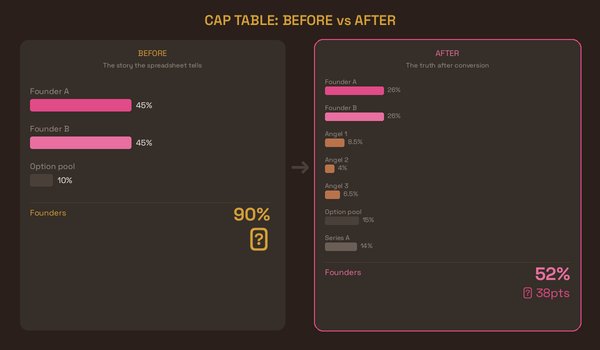
Combined founder ownership: 52%. Down from the 90% they'd been telling themselves. And here's what makes it worse: none of this was hidden. Nobody lied. Nobody acted in bad faith. The math was always going to land here. The founders just never asked the spreadsheet the right questions.
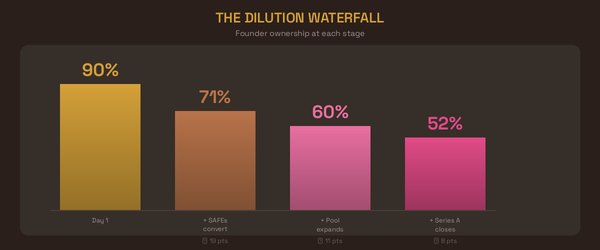
Why stories like this keep repeating
There are three reasons, and they show up in almost every version of this story I've seen.
The invisible instrument problem. SAFEs live outside your cap table until they convert. So you issue one, then another, then a third, and your spreadsheet keeps telling you a story that stopped being true months ago. It's like checking your bank balance without counting all the pizza you ordered on Uber Eats last weekend. The number looks fine until it doesn't.

The scenario nobody models. Every time I sit down with a founder, I ask the same question: "What does your cap table look like if you raise your Series A at $8M instead of $12M?" The most common answer is a pause, followed by "I'd have to ask my lawyer." That pause is where the problem lives. Your lawyer should have already walked you through this. If they haven't, they're processing paperwork, not doing architecture.
The option pool shuffle. This one is subtle, and I want to explain it gently because it's not anyone being malicious. It's just how the game works.
When a VC says they want a 15% option pool "post-money," it sounds reasonable. But the standard practice is that this pool comes from the founders' shares, not from the new investment. So before the round closes, the founders dilute themselves to create the pool. The VC's percentage is calculated after that dilution.
It's standard. It's legal. And it means the founders are quietly paying for something that benefits the company broadly. Most founders don't fully understand this mechanic until after the documents are signed. Not because anyone hid it. Just because nobody explained it in plain language.
What you can do about it
The good news is that none of this is complicated. It's just maths that nobody does until the moment it matters.
Model your SAFEs today.

I built a free cap table calculator you can use right now. It's pre-filled with the example from this story, so you can see the mechanics in action. Then clear the yellow cells and plug in your own numbers.
Google Sheet · click to make your own copy
Enter your founders, your SAFEs, your Series A terms, and watch what happens. Model what happens at three different valuations: your optimistic case, a realistic one, and the scenario you'd rather not think about. If you can see the range, you can make informed decisions. If you can't, you're writing a story without knowing the ending.
Keep a running total. Every time you issue a new SAFE, update the model. If the next one pushes your combined founder ownership below 50% at any reasonable conversion scenario, that's worth a conversation before you sign.
Understand the option pool before you negotiate. When a term sheet says "15% option pool," ask: pre-money or post-money? Who bears the dilution? Is the pool sized for your actual hiring plan, or is it bigger than you need? These aren't adversarial questions. They're structural ones. Good investors will respect you for asking.
Get a proper cap table tool. Carta, Pulley, Ledgy, whatever works in your jurisdiction. Not a spreadsheet. A tool that models conversion scenarios and shows you the real numbers. Because spreadsheets don't update themselves, and the gap between what you think you own and what you actually own tends to grow quietly.
The Blueprint
Cap Table Reality Check: 5 Questions
Grab the free calculator and answer these five questions:
The Docket
Things that caught my eye this week
The Question
When did you first realise your cap table was off?
Click the one that's you.
Every click opens an email. Add your story or just send it blank. I read every one.
Writing this from Barcelona, where the jacarandas are about to bloom and the terrace is finally warm enough to work from again. Next issue lands next Monday. Until then, maybe go check that spreadsheet. Just in case.
Have a great day ahead,
Pepe Carrillo
Founder, Mexzungu Group · Venture Architect
mexzungu.com · pepecarrillo.co · LinkedIn
Mexzungu Group · Outlaw Studio · Barcelona
The Outlaw Chronicles is for educational purposes only. It does not constitute legal, financial, or professional advice. For structuring decisions, engage qualified professionals in your jurisdiction.
Unsubscribe · AI Policy · Privacy