
Mission Briefing
Alfi and Andy started the company on the same day, from the same table, with the same conviction. They split it 50/50 because they were equal partners and that felt right. There was no vesting schedule. There was no buyback clause. Andy left in month nine. By month forty-eight, he owned 50% of a company he had not touched in three years, and Alfi needed his signature on a term sheet she had spent eighteen months building toward. This issue is about what happens when the equity split outlives the partnership.
Venture Odyssey
Departure: Equal partners, equal shares

: Fifty-fifty, no vesting, no buyback
Alfi and Andy had met at a hackathon. Alfi was building the product. Andy was building the pitch. They worked for thirty-six hours straight, came second, and decided that second place at a hackathon was a reasonable origin story for a company that was going to do something real.
They incorporated two weeks later. Alfi carries a tablet everywhere, and the tablet that day showed a simple document: two founders, equal contribution, equal ownership. 50/50. They had a conversation about it that lasted maybe twenty minutes, which is the amount of time most co-founding equity conversations last. Equal felt fair. Equal felt clean. Equal felt like the kind of thing friends did when they trusted each other.
There was no vesting schedule because neither of them knew that vesting schedules were a thing co-founders did. They knew employees vested. They did not know founders vested. Nobody had explained it, and they did not ask, because there was a company to build.
There was no buyback clause because they were not planning on buying anything back. They were planning on building something together for a long time.
Andy had a purple-tinted quality to his presence, from Andromeda, a particular kind of confidence that came from having been through one round of something before and believing he understood how things worked. He was good at the external work. The pitch. The investor meetings. The partnership conversations. He was less good at, and less interested in, the operational grind that came after the pitch and before the next milestone. This did not emerge immediately. It emerged slowly.
Month four: Andy was leading the conversations with potential customers and disappearing for two or three days at a time to "think about strategy." Alfi noticed and did not say anything because they were still in the phase where everything was fragile and direct conversations felt like too much.
Month seven: Andy started an MBA program on the side. He mentioned it at the end of a Monday meeting. Alfi said congratulations and meant it and spent the following week understanding what an MBA program actually required of its students' time.
Month nine: Andy asked for a conversation. He said he had decided to focus on the MBA full-time. He said he still believed in the company. He said he wanted to stay involved at an advisory level. He said he was not giving up his equity because he had built the original pitch and many of the customer relationships and he believed his contribution warranted keeping his shares.
He had 50% of the company. He had worked nine of what would become forty-eight months. He had signed no vesting schedule. He had signed no buyback clause.
He was not wrong about the contribution. He was also not there.
Layover: The signature that was not available
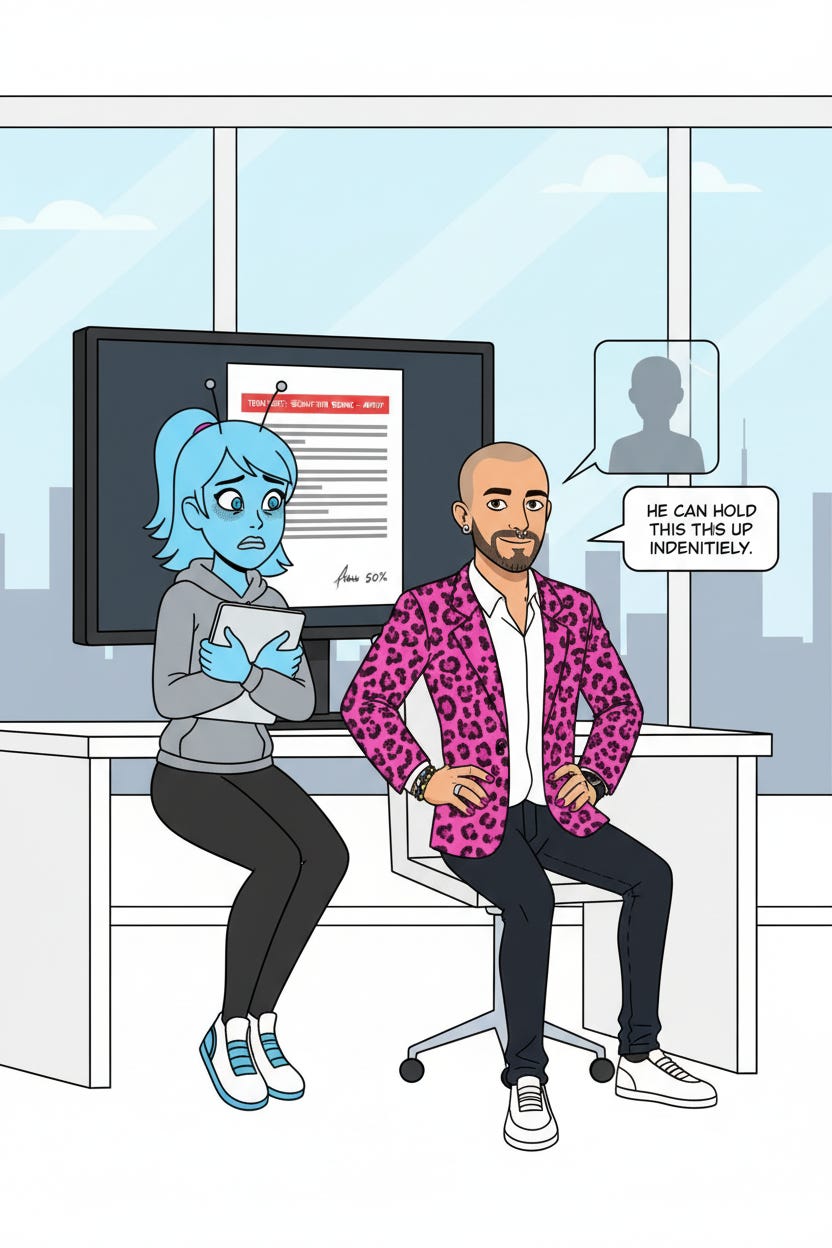
: He can hold this up indefinitely
Alfi built the next thirty-nine months alone, with a team she hired and a product she shipped and a revenue number that eventually attracted a Series A lead investor.
Perry's term sheet arrived and it was everything she had been working toward. $4.5M. Fair valuation. Clean terms. A lead investor who made warm introductions before he wrote cheques. She was ready to close.
The term sheet required all shareholders holding more than 10% to sign the closing documents. There was one shareholder holding 50%. Andy.
She had not spoken to Andy in fourteen months. The last message she had from him was a congratulatory note when she announced the product launch on a business networking platform. She had thanked him. That was the end of the thread.
She sent him an email. He replied three days later. He said he was glad to hear the company was doing well. He said he would need to review the term sheet carefully before he signed anything. He said he had questions about the valuation and about how his position would look after the round.
She forwarded the email to her lawyer. Her lawyer read it and was quiet for a moment before he spoke.
"He can hold this up," the lawyer said.
"For how long?"
"Indefinitely, if he chooses to. There is no mechanism in your current documents that compels him to sign. He is a 50% shareholder with full legal standing to review, object to, negotiate over, and delay the closing of any transaction that affects the company's capitalization."
Alfi said: "He worked here for nine months."
"That is accurate. It is also not the legal question. The legal question is what the documents say."
The documents said 50/50. No vesting. No buyback. No drag-along that applied to this transaction. No mechanism that converted non-participation into consent.
She called me from Barcelona. I was in the office on a Tuesday afternoon. She explained the situation in the flat, precise way of someone who has been holding a difficult truth for long enough that all the emotion has dried out of it.
"I need to know what my options are," she said.
I walked her through them. They were not numerous. She could negotiate with Andy directly, which meant having a conversation she had been avoiding for over a year and potentially paying him to sign. She could pursue a legal claim that his refusal to sign was a breach of some implied duty, which was possible but slow and expensive and uncertain. She could restructure the transaction in a way that did not require his signature, which her lawyers were not confident was available given the current cap table architecture. Or she could wait.
She waited four months. During those four months, her lead investor's fund began its quarterly deployment cycle and began to look at other opportunities. The original term sheet expired. Perry called her and said he still wanted to invest but the valuation would need to be revised to reflect the additional time and market movement.
The revised term sheet was $500,000 lower on the valuation. Andy eventually signed, after two conversations, a legal letter, and an agreement to repurchase a portion of his shares at a modest premium to give him a clean exit.
"The total cost of the delay," her lawyer told her at close, "was about $1.2 million in reduced valuation plus legal fees and the management time you spent on this instead of building."
"For nine months of work," she said.
"For nine months of work and no vesting schedule," he said.
Arrival: The conversation you do not have in month one

: Vesting plus buyback plus drag-along
The 50/50 split is not the problem. Equal co-founders who contribute equally for the life of the company build extraordinary things. The problem is the absence of vesting, and the absence of a buyback clause, and the assumption that the equity represents a future relationship rather than a past one.
Founder vesting is the mechanism that ties equity to continued contribution. A standard four-year vest with a one-year cliff means that if a co-founder leaves in month nine, they leave with the equity they have earned rather than the equity they were promised for four years of contribution. A co-founder who leaves after nine months of a four-year vest with a one-year cliff has earned nothing yet. They leave with zero vested shares and potentially a right to a portion of their unvested shares through a buyback at cost. The company gets the shares back. The cap table reflects reality.
None of this requires malice or anticipation. It requires the conversation in month one that feels unnecessary because everything is going well, and is easiest to have precisely because everything is going well.
Think of it like a marriage with a prenuptial agreement. The prenuptial agreement is not a statement that you expect the marriage to fail. It is a document that says: we care enough about this relationship to be honest about what happens if circumstances change, because circumstances sometimes do, and we would rather have that conversation now than in a different emotional register later.
The equity split conversation that happens on the day you incorporate is the only day in the company's life when that conversation is genuinely easy. Use it. Four years of vesting. One-year cliff. A company buyback right at cost or a small premium for shares that have not vested. A drag-along provision that ensures minority shareholders cannot hold up a future transaction indefinitely.
Alfi built a great company. She just built it carrying a ghost on her cap table.
The Blueprint
Institute four-year vesting with a one-year cliff for every founder, including yourself, before you incorporate or immediately after. This is non-negotiable if you care about the company surviving a co-founder departure. Done looks like: a signed founders' agreement with a vesting schedule that starts from your first day of work and includes a clear cliff date.
Include a company buyback right for unvested shares. If a co-founder leaves before fully vesting, the company has the right to repurchase their unvested shares at the original price paid. This prevents ghost equity from accumulating on the cap table. Done looks like: a buyback clause in the founders' agreement that specifies the buyback price, the exercise period, and the trigger events.
Add a drag-along clause that applies to major transactions. A properly drafted drag-along requires minority shareholders above a threshold to vote in favour of a transaction approved by a majority of shareholders and the board. This prevents a minority holder from blocking a round or an exit that the rest of the company has agreed to. Done looks like: your shareholders' agreement contains a drag-along provision and your lawyers have confirmed it applies to financing transactions.
Have the equity conversation explicitly on founding day. Not "this seems fair," but "here is what happens if one of us leaves in month six, in month eighteen, and after we are fully vested." Write down what you agree. Sign it. Put it in the data room. Done looks like: a founders' agreement that is not a standard form with your names inserted, but a document that reflects your specific conversation about these specific scenarios.
Revisit the cap table every time you are about to raise. Before any financing round, confirm that every shareholder above a meaningful threshold is findable, reachable, and likely to cooperate with the closing process. If someone is not findable, that is a due diligence risk you need to disclose. Done looks like: a list of all shareholders, their contact information, and their last known status, reviewed sixty days before any planned closing.
Free resource: Founder Vesting Decision Tree. Four questions, see exactly which document your cap table is missing: vesting, buyback, drag-along, or cap table hygiene. See below.
Curious Corner
Slicing Pie by Mike Moyer : A dynamic equity model for early-stage companies that ties share ownership to actual contribution over time. Not right for every company, but a useful framework for thinking about how equity should reflect reality rather than projections made on day one.
Founders Dilemmas: Chapter on Equity by Noam Wasserman : Harvard Business School research on co-founder equity splits across hundreds of startups. The data on outcomes for companies with equal splits versus negotiated splits, and with and without vesting, is sobering and useful. Read the summary before you have the founding day conversation.
The Free Resource
The Founder Vesting Decision Tree. Four questions on vesting, buyback, drag-along, and cap table hygiene. See exactly which document you are missing before a co-founder departure turns into a blocked round. Runs in the browser, nothing to download.
The Question
When you co-founded your company, did you have an explicit conversation about what would happen to the equity if one of you left in month nine? Not a vague agreement that you would figure it out. An actual conversation with a specific answer. If you did, I want to know how you handled it and whether the document matched the conversation. If you did not, you now know why that conversation matters. Hit reply.
Writing this from Barcelona, where I had an espresso this morning and watched a founder walk through this exact scenario from their phone while sitting across from me at a terrace table. It was an interesting forty minutes for everyone involved. Next issue: the co-founder who left eighteen months ago and still owns 25%, and why that number is blocking the next raise.
Have the conversation now. The version of it in month one takes twenty minutes. The version of it in month forty-eight costs considerably more.
Pepe
The Outlaw Chronicles is for education only. Nothing here is legal advice. For the real thing, you know where to find me.