

Mission Briefing
Sirix knew for six months that his co-founder had stopped building. He said nothing, because the timing never felt right. Every one of those months had a price, written into a vesting schedule he had insisted on himself. The bill came to $340,000 and one Series A lead. This issue is about the meter that runs while you wait.
Venture Odyssey
Departure: Attempt three
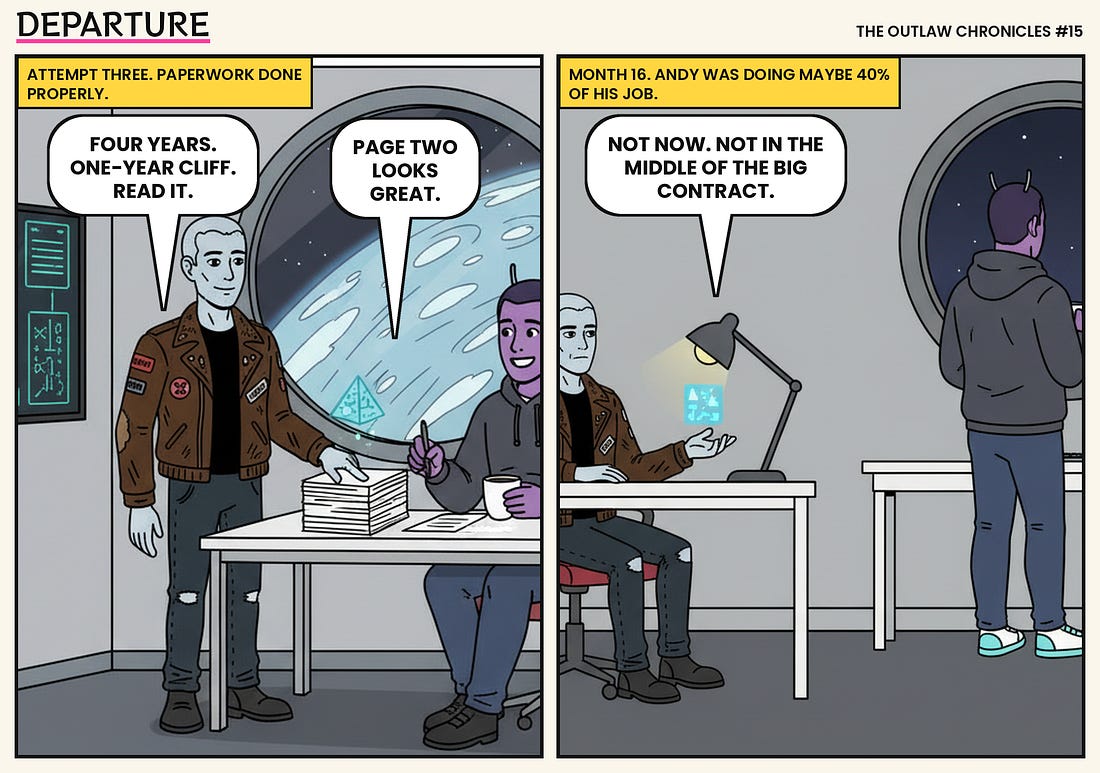
Attempt three. Paperwork done properly.
From the Guide: Sirius. The brightest star in the night sky, and home to founders who keep score on their own wrists.
Sirix keeps score on his wrist. A small hologram floats above the steel of his forearm and reads, in calm blue light: Companies 3, Exits 1, Failures 2, Currently: attempt 3. He never turns it off. He says the full ledger is more honest than the highlight reel, and that people who have failed twice in public have nothing left to hide behind anyway.
The rest of him matches the counter. Matte silver skin like brushed steel that has absorbed too much light. Two small cybernetic implants at the temples, slightly misaligned, fitted after the fact. A faint scar along the jaw. A half-smile that never quite goes back to neutral. A leather jacket with a patch on the back for every company he has started, some faded, one burned at the edges. That one is company two.
Company two died of something nobody would name. His co-founder stopped showing up, a little at a time, for fourteen months. Everyone saw it. Nobody said it. By the time the lawyers named it, the naming was the most expensive thing the company ever bought.
So attempt three was going to be different, and on paper it was. Sirix built predictive maintenance for orbital stations: software that tells a station crew which airlock seal will fail before it fails. He started it with Andy, from Andromeda. Deep lavender skin, two slim silver antennae you only notice when the light hits them, and the build of a rugby player who wandered into a startup by mistake. Andy carries a coffee cup everywhere and never seems to drink from it. In a room full of nervous station operators, he nods slowly and the room calms down. Sirix wrote the code. Andy sold it.
They did the paperwork properly this time. Sirix insisted. Andy held 3,600,000 shares, 36% of the company at founding, on a standard schedule: four years of vesting, a one-year cliff, then monthly. In plain words, Andy earned his shares by staying. Nothing until month twelve (the station calendar still runs on Earth months, because nobody in the galaxy could agree on anything better), then a quarter of them at once, then 75,000 more every month he kept working. If he left, the company could buy back whatever had not vested yet, at the fraction of a cent he paid for it. Whatever had vested was his to keep.
Andy signed without reading past page two. Everything was going well. Documents feel theoretical when everything is going well.
The first year was the good kind of hard. Contracts with three stations. A waitlist from a fourth. Then, somewhere around month fourteen, Andy got quieter. He missed one renewal call, then a second. He said things were complicated at home. Sirix said he understood, and he did.
By month sixteen, Andy was doing maybe 40% of his job. Sirix noticed on a Tuesday, the way you notice that a hum you have heard for weeks is actually a leak in the hull.
He said nothing. They were in the middle of the biggest contract the company had ever negotiated. The timing felt wrong.
That evening, the counter on his wrist still read attempt 3.
Layover: The question in the meeting room
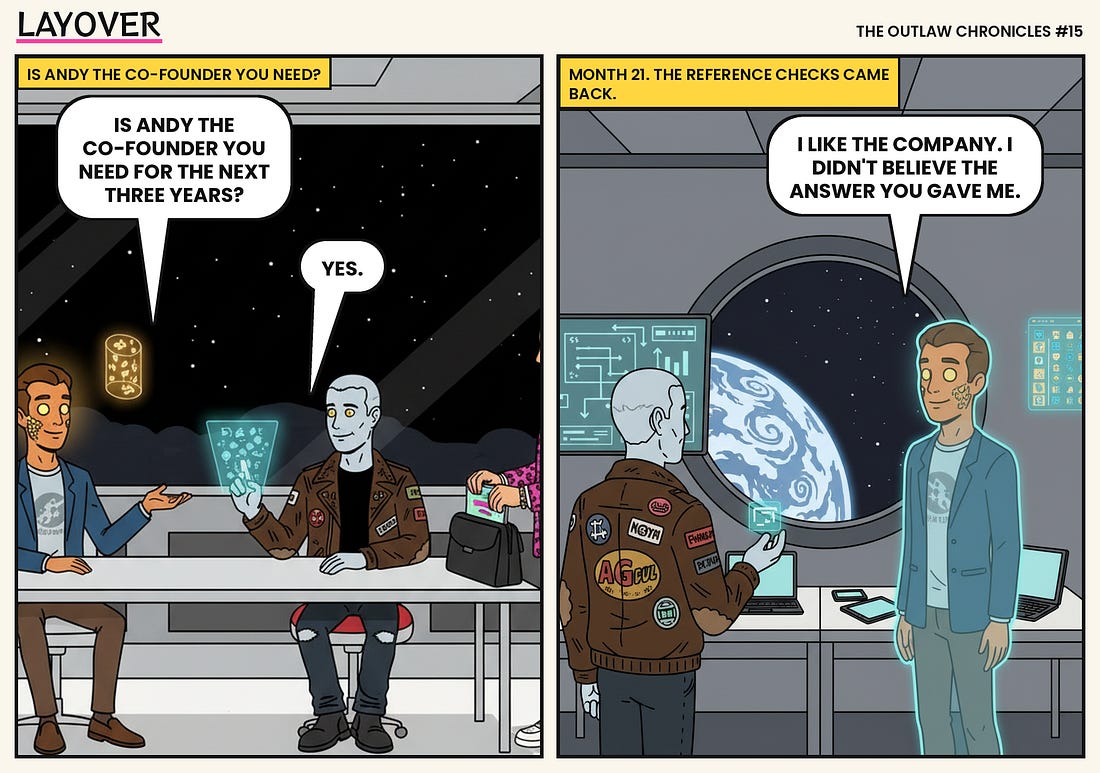
Is Andy the co-founder you need?
From the Guide: A vesting schedule is a clock. Clocks do not care whether anyone is looking at them.
Here is what Sirix knew and did not want to know. Every month he waited, another 75,000 of Andy's shares vested. Not as a penalty. Not as anybody's trick. That is simply what the schedule says: keep serving, keep earning. And on paper, Andy was still serving. He had a title, a calendar and one of the two seats on the board. The schedule cannot see effort. It can only see a date.
Month eighteen: Sirix raised it once, gently, folded inside a wider conversation about team performance. Andy said he was sorting things out. The conversation ended on a nod.
Month twenty: the Series A came looking. Perry, from Nova Centauri, had been tracking the company for a quarter. Warm amber skin, golden eyes with no white in them at all, and a rolodex hologram that drifts behind him like a loyal moon. Perry is the investor founders hope for. He reads the board pack before the meeting. He makes introductions before he writes checks. His associate had been holding weekly holographic check-ins with the team, and in the third one she asked Sirix something that sounded like small talk: "How do you and Andy split the work day to day?"
Sirix gave a careful answer. She made a note.
Then Perry asked for a meeting with both founders, real space, on the station where the company had its office. Sirix asked me to sit in, because a term sheet was coming and he wanted his lawyer to hear the room before reading the paper. So I took the shuttle up. I was in my pink leopard blazer, the only thing on that station that was not gray.
The meeting lasted two hours. Andy was good. Andy is always good in a room. He talked about the stations and the airlocks with that slow, steady nod. Perry listened with his golden eyes and asked three operational questions, all about the last six months. Andy answered every one of them in the future tense.
Afterward, Perry asked Sirix to stay behind. I was packing my tablet at the far end of the table.
"One question," Perry said. "Is Andy the co-founder you need for the next three years of building?"
Sirix's half-smile held. "Yes."
Perry looked at him for a long moment. "Okay," he said, kindly, and wrote something down.
In the shuttle bay, Sirix didn't look at me. "Don't," he said.
"I didn't say anything."
"You were going to."
"I was going to say you held that well."
"I didn't."
"No," I said. "But I have sat in that exact chair. Most of us have."
He glanced at his wrist out of habit, as if the counter would know. "Seventy-five thousand shares on the first of the month," he said, to nobody in particular. "And seventy-five thousand on the first of the month after that."
Then the shuttle came, and neither of us said anything else.
The term sheet arrived in month twenty-one. A good one, $0.80 a share, and conditional. One line in the closing conditions read: "Satisfactory completion of reference checks on the founding team." That line is standard. Nearly every term sheet carries a version of it. Funds call customers, former colleagues and anyone who has watched the founders work. Two of the three station customers mentioned, politely, that they had not heard from Andy in a while.
Two weeks later, Perry sent a holographic transmission himself, because Perry is the kind of investor who calls when the answer is no. "I like the company," he said. "I didn't believe the answer you gave me in that room. I can't lead a round for a team I don't believe."
Sirix called me that night. He did not ask what had happened.
"What does it cost now?" he said.
I walked him through it. The good news was the paperwork he had insisted on. The bad news was also the paperwork he had insisted on. At month sixteen, when Sirix first knew, Andy had vested 1,200,000 shares. This month, month twenty-two, Andy had vested 1,650,000. The difference was 450,000 shares. Six months of silence, paid in equity, to someone who had stopped building.
He had the conversation the next morning. Andy, to his enormous credit, was not difficult. He put the coffee cup down, which Sirix had never once seen him do. "I know," Andy said. "I've known since month fourteen. I kept waiting for you to say it, so I wouldn't have to." He resigned his role and his board seat that same week, and that stopped the vesting clock. (Both matter. Many plans count board service as service.)
Within the month, the company exercised its right to buy back Andy's 1,950,000 unvested shares at the fraction of a cent he had paid. One board resolution and a check small enough to frame.
The rest took four more months. Andy's lawyer did his job well. He proposed that Andy stay on as an advisor, which sounds generous, and partly was. The catch is that most vesting schedules keep running as long as you are providing services, and advising counts. Every month as an advisor would have been another 75,000 shares. Sirix's lawyer said no. Then the two sides argued over the release, the document where each side promises not to sue the other later, because the first draft was written so wide it would have let go of claims the company still needed. They argued over whether Andy's 1,650,000 vested shares should vote with the board on future rounds. All ordinary questions. All billed by the hour.
Arrival: The meter
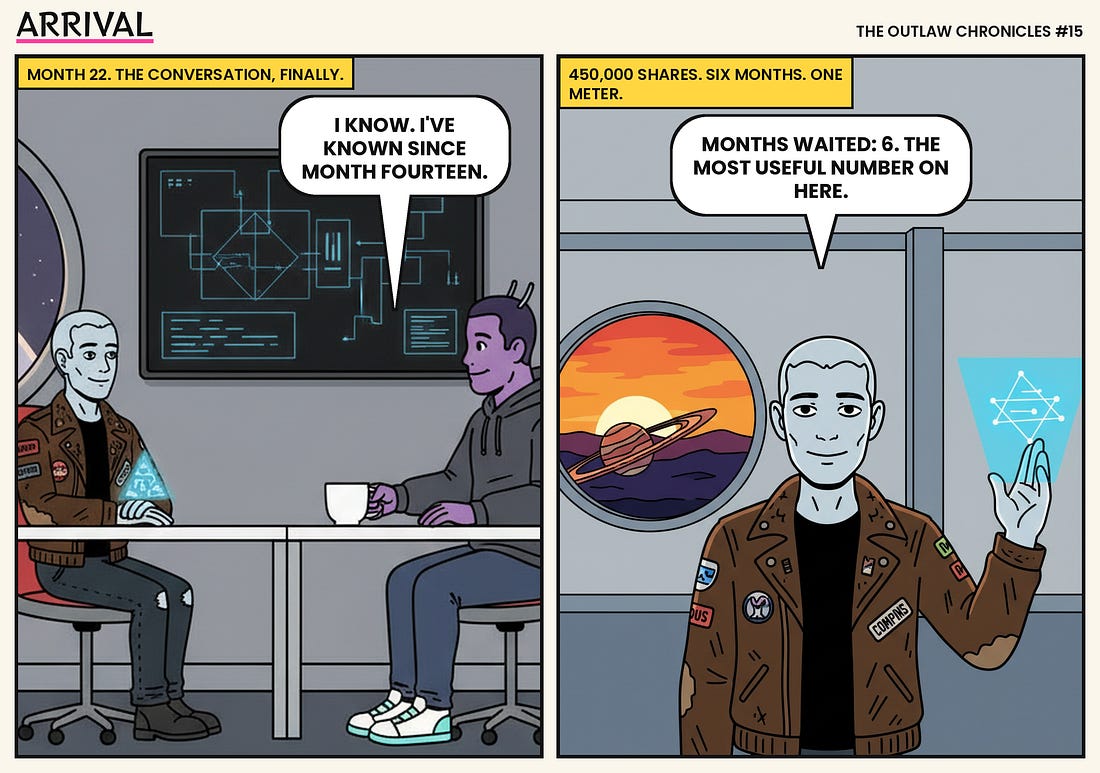
450,000 shares. Six months. One meter.
From the Guide: The cheapest hard conversation in the galaxy is the one you have the first week you know.
Andy kept his vested shares and signed a voting agreement, a promise to vote those shares alongside the board on future rounds so nobody outside the company could stall them. He signed the release too, and confirmed in writing that everything he had built belonged to the company. Six months after the separation closed, a smaller fund two systems over led the Series A at $0.60 a share.
So here is the bill, added up. 450,000 shares that vested while Sirix waited, worth $270,000 at the price the round closed. Legal fees of $80,000 (in Earth dollars, still the only currency lawyers across the galaxy agree to be paid in), against roughly $10,000 for a clean separation back in month sixteen. That is $70,000 of extra fees. $270,000 plus $70,000 is $340,000. Plus one Series A lead, which no spreadsheet has a cell for. (I am not even counting the drop from $0.80 a share to $0.60. Sirix does, usually around 3am.)
Now the mechanism, plainly. Vesting is a salary paid in shares. It does not measure contribution. It measures service, month by month, and it pays on the first of every month that someone is still formally in the job. That is exactly what you want when the partnership works. It is exactly what you are paying for when it doesn't.
Think of it like a gym membership on auto-renew. You stopped going in March. The gym does not know, and does not care. It charges you on the first of every month until somebody picks up the phone and cancels. Nobody at the gym is doing anything wrong. The contract is doing exactly what you signed.
Nobody in this story did anything wrong either. Andy was a good person in a role that no longer fit. Perry ran the checks every good lead runs. Andy's lawyer asked for what departing founders' lawyers always ask for. The documents worked perfectly. Documents just cannot have the conversation for you.
So if this story sounds a little familiar, the clock is already running. That is not a reason to panic. It is just a reason to pick a date. Sirix will tell you the first week you know is the cheapest week you will ever get.
Sirix added a line to the counter on his wrist. It now reads: Companies 3, Exits 1, Failures 2, Currently: attempt 3, Months waited: 6. He says it is the most useful number on there.
The Blueprint
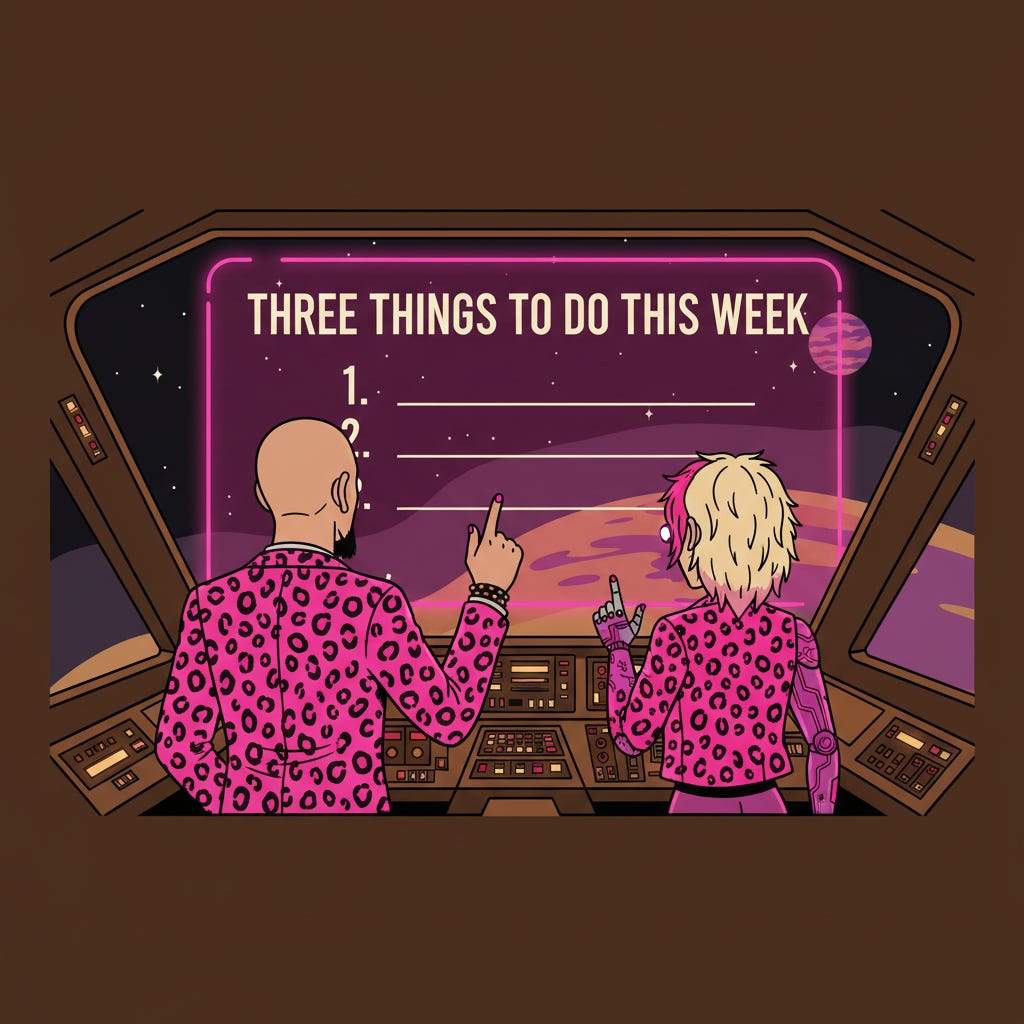
Three things to do this week.
From the Guide: Every month has a price. Read the price before you decide to wait.
Put a number on one more month. Open your vesting schedule and work out how many shares each co-founder earns next month, and what those shares are worth at your last round price. Done looks like: one line per co-founder, shares per month and dollars per month, written next to today's date.
Read your leaver terms before the conversation, not after. Find the repurchase right on unvested shares and its exercise deadline, what counts as continuing service (advisor roles and board seats included), and what happens to the board seat and the IP when a co-founder leaves. Done looks like: one page, in plain words, saying exactly what happens to shares, seat and IP if a co-founder steps out this month.
Put the conversation on the calendar. If you have known for more than ninety days, schedule it within the next two weeks, open with the role rather than the person, and bring a proposal built on the vesting schedule. Done looks like: a meeting invite sent today, and a one-paragraph proposal ready to put on the table.
Free resource: The Vesting Meter. Put in the schedule, the month you knew and the share price, and see what the wait cost. See below.
The Free Resource
The Vesting Meter. Enter your co-founder's shares, the vesting schedule and cliff, the month you first knew and your share price. The meter shows how many shares vested while you waited, what they are worth, what you can still buy back at cost, and what one more month will add. It scores the wait from 100 down, and Sirix's numbers are loaded so you can watch his six months add up to 450,000 shares. Runs in the browser, no sign-up.
Curious Corner
Three outside reads for anyone rehearsing a conversation they have not had yet.
Founder Basics: Founder's Stock, Vesting and Founder Departures: Cooley GO on the paperwork Sirix insisted on. Four-year vesting, the one-year cliff, and the company's right to buy back unvested shares when a founder leaves early. It reads fast, and it goes well past page two.
Prenups for Co-founders: Scott Kupor of Andreessen Horowitz argues co-founders should agree how a breakup works while they still like each other. Board seats tied to staying in the job and unvested equity going back to the people still building. Andy's board seat is the reason why.
How to Sink a Startup: Noam Wasserman, author of The Founder's Dilemmas, on the early decisions founders get wrong. He reads a quick equal split as a sign of a hard discussion being avoided, and names vesting as the protection. Sirix had the protection. He still had to have the discussion.
The Question
Think about the person on your team you have been waiting for the right moment to talk to. How many months have you known, and what did you tell yourself the last time the right moment came and went? Hit reply, I read every one.
Writing this from a small cabin in the mountains near El Perelló, in Catalonia, where the only ones who hear me rehearse difficult conversations out loud are the pine trees. Next issue: two friends split a company fifty-fifty on a napkin, and the first time they disagreed, nobody could break the tie. Now go have the conversation you keep rehearsing in the shower. Pepe
The Outlaw Chronicles is for education only. Nothing here is legal advice. For the real thing, you know where to find me.